Homeschool Missions Curriculum for California: A Family Guide
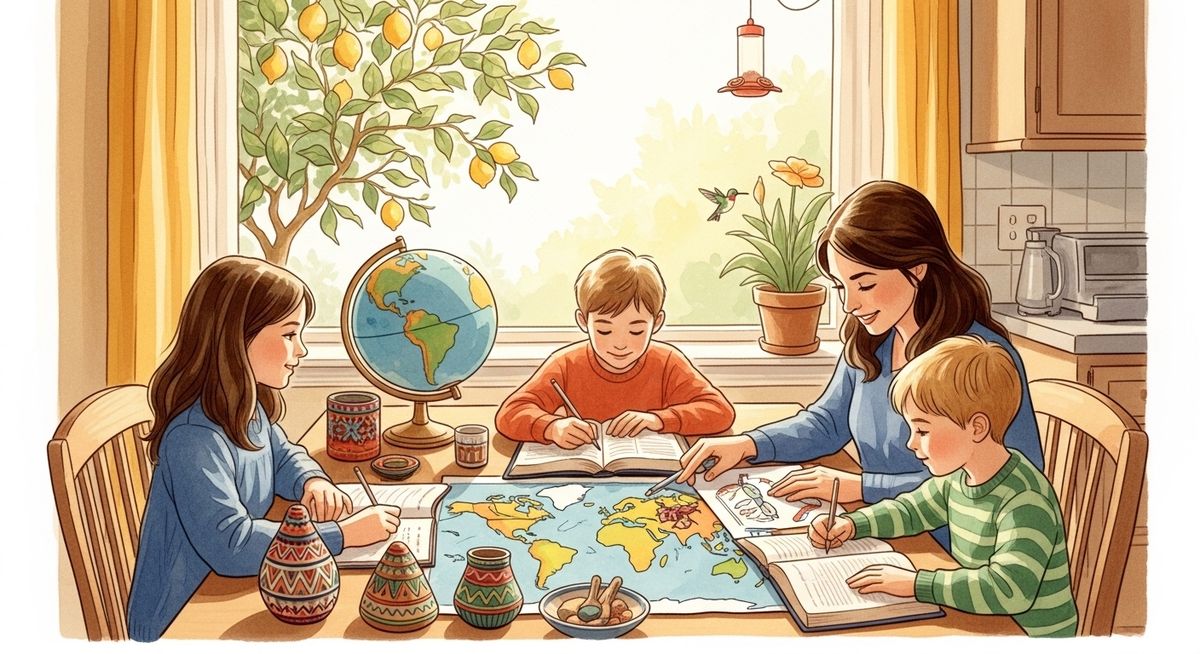
The marine layer had not yet burned off. It hung low over the neighborhood like a soft gray blanket, muffling the sounds of the street, turning the morning light diffuse and silver. Through the kitchen window, a lemon tree in the backyard held its fruit like small lanterns in the fog. An avocado tree beside it, heavy with dark green drupes, cast a shadow across the patio table where a hummingbird feeder swung gently in the coastal breeze.
Inside, the kitchen table was cleared. A globe sat at one end. A Bible lay open to Acts 17. Three children, ages six, nine, and twelve, sat with bowls of oatmeal and sliced strawberries. Their mother stood at the counter, holding a laminated card with a photograph of a woman in a bright orange sari standing in a field of yellow mustard flowers. The woman was Rajput. Northern India. Over 45 million people in that single community, and fewer than one in a thousand had ever heard the name of Jesus.
“This is where we are going today,” the mother said, and she set the card on the table between the oatmeal and the globe.
The six-year-old spun the globe. The twelve-year-old found India with her finger and began tracing the outline of Rajasthan. The nine-year-old read the pronunciation guide on the card and tried the word aloud: “Rahj-poot.” Outside, a mourning dove called from the fence. The fog was beginning to thin. The day’s lessons had already begun.
This is what missions education looks like for a California homeschool family. It does not require a separate curriculum. It does not require a flight to another continent. It requires a table, a card, a globe, and a willingness to say the names of people whom God loves and most of the world has forgotten.
This guide will walk you through California’s homeschool requirements, show you exactly where missions fits into the subjects your state expects you to teach, and give you a practical weekly schedule for weaving world missions into your family’s learning rhythm. If you are building a broader homeschool missions curriculum, this California-specific guide is designed to complement the frameworks and printable missions lesson plans already available.
California Homeschool Requirements and Where Missions Fits
California does not have a standalone homeschool statute. Instead, most homeschool families operate under one of two legal structures. The first and most common is filing a Private School Affidavit (PSA), submitted online through the California Department of Education between October 1 and October 15 each year. When you file the PSA, you are establishing your home as a private school. The second option is enrolling your children in a Private School Satellite Program (PSP), sometimes called an umbrella school, which provides oversight and record-keeping support.
Under California Education Code, private schools must offer instruction in the following subjects: English (including reading, writing, spelling, and grammar), mathematics, social sciences (including geography, history, civics, and economics), science, health, physical education, and fine arts. Instruction must be conducted primarily in English. There is no requirement for standardized testing, no mandatory reporting of grades, and no state-approved curriculum list. This gives California homeschool families remarkable freedom to design their own course of study.
Missions education does not sit awkwardly beside these requirements. It walks directly through the center of them. When your children study an unreached people group, they are learning geography and world cultures, which falls under social sciences. When they read a missionary biography or write a prayer journal entry, they are practicing reading and writing, which falls under English. When they cook a recipe from another culture, they are learning measurement and fractions, which falls under math. When they draw or color a scene from a people group’s daily life, they are producing fine arts. When they study monsoon cycles or desert ecosystems that shape how people live, they are learning science. A single missions lesson can touch five required subjects in fifteen minutes. The state of California does not prescribe how you teach these subjects. It only asks that you teach them. Missions is not an addition to your curriculum. It is a lens through which every subject comes alive.
Why Missions Belongs in Your California Homeschool
There is a temptation, even among families who love the global church, to treat missions as a supplement. Something you add on Friday afternoons when the real work is done. A special unit once a year. A prayer before dinner that mentions “missionaries” in a general, unspecific way.
But Scripture does not present God’s heart for the nations as a supplement. It is the storyline. The Bible opens with a God who creates all peoples (Genesis 1), narrows to one family through whom all peoples will be blessed (Genesis 12:3), and ends with a vision of every tribe, language, people, and nation gathered before the throne of the Lamb (Revelation 7:9). The entire arc of Scripture bends toward this moment. Every story between Genesis and Revelation is a chapter in God’s relentless pursuit of worshipers from every corner of the earth.
John Piper put it simply, and it has become one of the most quoted sentences in modern missions theology:
“Missions exists because worship doesn’t. When the age of missions is over, the age of worship will have just begun.”
This is not sentimentalism. It is a theological claim with weight. If God’s purpose in history is to gather worshipers from every people group on earth, then teaching our children about the peoples who have not yet heard is not an elective. It is central to understanding who God is and what he is doing. When we teach our children math, we are teaching them to think with precision. When we teach them to read, we are giving them access to the accumulated wisdom of centuries. When we teach them missions, we are inviting them into the story that gives all other stories their meaning.
For California families, this matters in a particular way. Your children are growing up in one of the most ethnically diverse places on earth. The nations are not abstract. They are next door. The Hmong family at the farmers market. The Iranian shopkeeper on the corner. The Korean church that shares a parking lot with yours on Sunday mornings. Missions is not only about sending people far away. It is about seeing the people God has already brought near.
A Weekly Missions Schedule for California Families
The following schedule integrates missions into a typical homeschool week using three time formats. Choose the one that fits your family’s rhythm. For detailed lesson frameworks, see our printable missions lesson plans.
Option A: The 15-Minute Weekly Rhythm
| Day | Time | Activity | Subject Integration |
|---|---|---|---|
| Monday | 15 min | People group introduction: name, location, map work, one cultural fact, prayer | Social Sciences, Fine Arts |
| Wednesday | 10 min | Read a missionary biography excerpt aloud | English (Reading) |
| Friday | 10 min | Missions journal entry: write or draw what you learned this week | English (Writing), Fine Arts |
Option B: The 30-Minute Twice-Weekly Rhythm
| Day | Time | Activity | Subject Integration |
|---|---|---|---|
| Tuesday | 30 min | People group study: profile, map work, Scripture passage, discussion | Social Sciences, English |
| Thursday | 30 min | Response activity: missions journal, coloring page, craft project, or cooking activity | Fine Arts, Math (cooking), Science |
Option C: The 1-Hour Weekly Deep Dive
| Day | Time | Activity | Subject Integration |
|---|---|---|---|
| Wednesday | 60 min | Full immersion: map work, people group profile, Scripture study, cultural activity, journal reflection, extended prayer | Social Sciences, English, Fine Arts, Science, Math |
Any of these options, sustained over a thirty-six-week school year, will expose your children to dozens of unreached people groups, hundreds of pages of Scripture, and a lifetime of names to carry in prayer. The key is consistency, not intensity. Fifteen minutes every Monday is better than a three-hour marathon once a semester.
California-Specific Connections: The Nations Next Door
California is not simply a place where you teach about the world. It is a place where the world already lives. With nearly 40 million residents representing virtually every ethnicity on the globe, your state offers something most missions curricula cannot: direct, daily contact with the peoples your children are learning about. Here is how to connect your missions studies to the communities around you.
Pacific Rim Gateway
California’s coastline faces Asia, and for over 150 years, immigrants from across the Pacific have made this state their home. The Chinese community in California is one of the oldest and largest in the Western Hemisphere. Vietnamese families settled throughout Orange County and San Jose after 1975. Filipino communities thrive in Daly City, Carson, and the Central Valley. Korean families built Koreatown in Los Angeles into one of the most vibrant Korean neighborhoods outside Seoul. Japanese Americans, many of whose families have been in California for four or five generations, maintain cultural centers and temples from San Francisco’s Japantown to Little Tokyo in Los Angeles.
When your children study unreached people groups in East and Southeast Asia, remind them that many of these same peoples have neighbors, classmates, and shopkeepers in their own California community. The Hmong people, originally from the mountains of Laos and northern Vietnam, have a large and thriving population in Fresno, Sacramento, and the Central Valley. A lesson on the Hmong can include a trip to a Hmong-owned market to buy lemongrass and sticky rice for a cooking activity.
Central Valley Communities
The Central Valley is one of the most ethnically diverse agricultural regions in the world. Punjabi Sikh families have farmed in the Yuba City and Stockton areas for over a century. Afghan refugees have settled in Sacramento, Fremont, and Modesto, building mosques and community centers and opening restaurants that serve kabuli pulao and bolani. Hmong families, as mentioned, are concentrated in Fresno and Merced. When your children study South Asian or Central Asian people groups, the Central Valley offers tangible, local connections that transform abstract lessons into real encounters.
Los Angeles: A City of Nations
Los Angeles County alone is home to communities from nearly every unreached people group region on earth. Tehrangeles, the informal name for the large Iranian community in Westwood and Beverly Hills, is the largest concentration of Iranians outside Iran. Armenian families, many of whom fled genocide and later conflict, have built a vibrant community in Glendale. Thai Town in East Hollywood is the only officially designated Thai neighborhood in the United States. Ethiopian and Eritrean communities gather along Fairfax Avenue, where the smell of injera and berbere spice drifts from dozens of restaurants. Little Tokyo, Koreatown, Historic Filipinotown, and Chinatown each preserve and celebrate distinct cultural identities.
For your homeschool, this means that a lesson on the 10/40 Window is not a lesson about faraway places only. It is a lesson about the families who live thirty minutes down the freeway. Consider planning a field trip to one of these neighborhoods. Walk through a Korean grocery store. Visit a Japanese garden. Eat injera with your hands at an Ethiopian restaurant. Let your children taste, smell, and see the cultures they have been praying for.
The San Francisco Bay Area
The Bay Area is routinely cited as one of the most diverse metropolitan regions on earth. Fremont has a large Afghan community. Milpitas and Sunnyvale have significant Indian populations. Richmond and Oakland are home to Laotian, Cambodian, and Mien families. The diversity is not clustered in one neighborhood; it is woven into the fabric of daily life. A trip to a Bay Area farmers market on a Saturday morning is a missions lesson in itself.
Southern California and the Border
Southern California’s proximity to Mexico and Central America means that millions of families in your region speak Spanish as a first language. Many are from indigenous communities in Oaxaca, Guatemala, and Honduras, peoples with their own languages, traditions, and spiritual needs distinct from the dominant culture. A missions curriculum that focuses exclusively on Asia and Africa misses the peoples God has placed at your southern border. Consider adding a unit on indigenous peoples of Latin America. Study the Mixtec, the Zapotec, the Q’eqchi’ Maya. Learn about the Bible translation work happening in these communities. Your children may discover that some of the least-reached peoples in the Western Hemisphere live within driving distance of their home.
Wonder Letters: A Monthly Missions Companion
If you want a ready-made, hands-on supplement to your missions studies, Wonder Letters delivers a hand-illustrated letter about an unreached people group to your mailbox every month. Each letter is written from a child’s perspective, includes cultural details, a QR code linking to bonus content, activities, and a prayer guide. It is designed for ages 4 to 12 and works beautifully alongside any homeschool curriculum.
For California families, Wonder Letters adds something that a textbook cannot: a physical, beautiful, collectible piece of mail that your children look forward to receiving. It arrives in the mailbox between the electric bill and the grocery flyer, and it carries the name of a people group your family has never heard of. Over twelve months, your children will have met twelve unreached communities, prayed for them by name, and built a small library of illustrated profiles they can return to again and again.
A monthly subscription is ten dollars. An annual subscription saves you even more, and fifty percent of every dollar goes directly to support work among unreached people groups through Global Serve International. Your subscription is not just a curriculum resource. It is an act of participation in the work of the Great Commission.
Free Resources to Build Your California Missions Curriculum
You do not need to spend hundreds of dollars on curriculum packages to teach your children about the nations. The following resources are free, printable, and designed to work in short lessons that fit a homeschool schedule.
Lesson Plans and Frameworks
Start with our printable missions lesson plans, which provide complete frameworks in 15-minute, 30-minute, and 1-hour formats. These are the backbone of any missions curriculum. Print one card per week, and you have a full year of lessons with no preparation beyond reading the card aloud.
People Group Studies
Our guide to unreached people groups explains what the term means, why it matters, and how to teach it to children of different ages. Pair it with the 10/40 Window article for a geography-focused introduction to the regions where most unreached peoples live.
Scripture and Theology
For families who want to ground their missions study in Scripture, our collections of Bible verses about missions and great commission Bible verses provide curated passages organized by theme. The Psalm 67 study is a wonderful single-session lesson that connects worship and missions through one of the most beautiful psalms in Scripture.
Hands-On Activities
Children learn by doing. Our missions coloring pages and Christian coloring pages are free to download and print. For older children, missions journaling provides a structured way to reflect on what they are learning. Missions craft projects offer culturally connected activities, and around the world cooking activities let your family taste the food of the peoples they are studying.
Prayer
Prayer is the heartbeat of missions education. Our missions prayer cards for kids are printable cards with a people group name, a photograph, key facts, and a prayer prompt on each one. Use them at the dinner table, in the car, or during bedtime prayers. The guide to praying for unreached people groups offers a deeper framework for families who want to develop a sustained prayer rhythm for the nations.
Missionary Biographies
Stories of men and women who gave their lives for the gospel are among the most powerful teaching tools available. Our missionary heroes series includes profiles of Hudson Taylor, Amy Carmichael, Jim Elliot, William Carey, Lottie Moon, and many others. Each profile is written for families, with discussion questions and prayer prompts included.
Bringing It Home: A Final Reflection
The fog burns off by mid-morning in most of coastal California. The lemon tree sharpens into focus. The neighborhood sounds return: a dog barking, a skateboard on the sidewalk, a conversation in Mandarin drifting over the fence from the house next door. The world is not far away. It is right here.
When you teach your children about the Rajput of India, the Hmong of Laos, the Baloch of Pakistan, or the Berber of Morocco, you are not teaching them about strangers. You are teaching them about image-bearers of God, people created with dignity, purpose, and an eternal soul, people for whom Christ died and for whom the Spirit is even now preparing a way. You are teaching them that the God who made the Pacific Ocean and the Sierra Nevada and the avocado tree in the backyard is the same God who said, “I will be exalted among the nations” (Psalm 46:10). You are teaching them that worship is the goal, missions is the means, and their kitchen table is the starting point.
Begin this week. Print one lesson card. Spin the globe. Say one name. Pray one prayer. The nations are waiting, and your children are ready.
Explore Guides for Other States
Every state has homeschool families teaching their children about God’s heart for the nations. Browse our other state-specific guides, or return to the Homeschool Missions Curriculum hub for a complete framework.
- Homeschool Missions Curriculum for Florida
- Homeschool Missions Curriculum for Georgia
- Homeschool Missions Curriculum for Illinois
- Homeschool Missions Curriculum for New York
- Homeschool Missions Curriculum for North Carolina
- Homeschool Missions Curriculum for Ohio
- Homeschool Missions Curriculum for Pennsylvania
- Homeschool Missions Curriculum for Texas
- Homeschool Missions Curriculum for Virginia
Brought to you by Wonder Letters
Monthly missions letters for families. 50% of profits support Global Serve International.