Homeschool Missions Curriculum for Florida: A Family Guide
A Morning in Florida
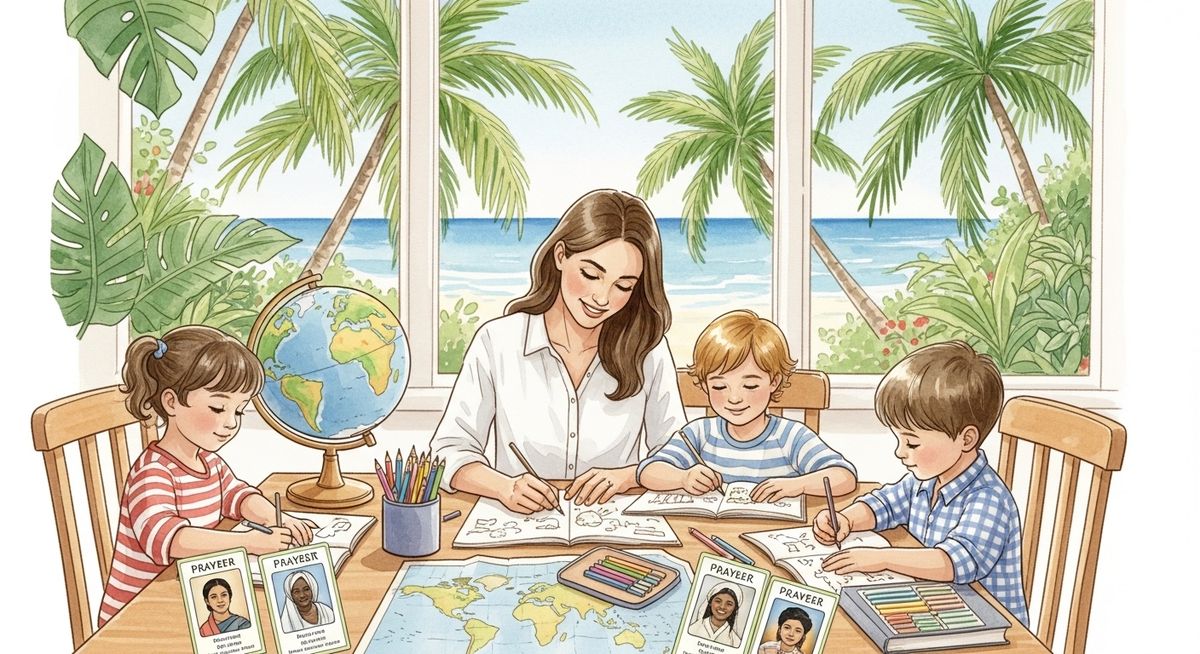
The ceiling fan hums above the kitchen table, turning slow circles against the warm air that presses through the screen door. Outside, the palms along the back fence catch the morning breeze, and somewhere down the street a neighbor’s sprinkler ticks across a lawn. It is nine o’clock in central Florida, and the Hernandez family has already cleared breakfast, stacked the dishes, and spread their schoolwork across the table. There is a geography textbook open to a map of Southeast Asia, a basket of colored pencils, and a single printed page with a photograph of a Rohingya family standing in a rice field.
Lucia, who is eight, traces the coastline of Myanmar with her finger. Her younger brother, Mateo, leans close to study the picture. Their mother sits between them with a cup of coffee growing cool in her hand and reads aloud from a prayer guide. The words are simple. The family in the photograph speaks a language they have never heard. They live in a place the children cannot yet find on a globe without help. But this morning, the Hernandez kitchen is connected to that family by something deeper than geography.
This is what missions education looks like in a Florida homeschool. Not a separate subject crammed into an already full schedule. Not a unit study reserved for November. It is a thread woven through the ordinary fabric of the school day, turning reading into encounter, geography into intercession, and history into a story that has not yet reached its final chapter. It starts at the kitchen table because that is where most good things in a homeschool begin.
And it starts with a conviction that God himself has placed at the center of Scripture: his glory will be known among every nation, every tribe, every tongue. “May God be gracious to us and bless us and make his face to shine upon us, that your way may be known on earth, your saving power among all nations” (Psalm 67:1-2). The blessing is never the destination. The blessing is always the road that leads outward, toward the peoples who have not yet heard.
Florida Homeschool Requirements at a Glance
If you are homeschooling in Florida, you already know the framework is relatively straightforward. Florida Statute Section 1002.01 requires families to file a notice of intent with their county superintendent within 30 days of beginning a home education program. You are required to maintain a portfolio of records and materials, including a log of texts and sample work. And each year, your child must be evaluated, either by a certified teacher who reviews the portfolio or through a standardized test.
There is also the option of enrolling through a private umbrella school under Section 1002.41. In that case, the umbrella school handles much of the administrative oversight, and families often have more flexibility in how they document their curriculum choices. Either path works well for integrating missions education.
The beauty of missions curriculum is that it does not require a separate line item in your portfolio. When your child reads a biography of Hudson Taylor, that is reading and language arts. When she colors a map of North Africa and labels the countries where the gospel has not yet taken root, that is geography and social studies. When he writes a prayer for the Sundanese people of Indonesia, that is composition. Missions education does not compete with your required subjects. It enriches them, giving your children a reason to care about the places and peoples they are studying.
Why Missions Belongs in Your Florida Homeschool
There is a question that sits beneath every curriculum decision a Christian parent makes, whether we name it or not: What are we forming our children for? We teach them to read so they can know God’s Word. We teach them math so they can steward what he gives. We teach them history so they can see his hand moving through centuries of human rebellion and redemption. But if we stop there, if the education turns inward and never lifts the child’s eyes beyond the borders of her own life, we have missed something essential about the God we are teaching her to love.
John Piper’s now-famous line captures it with precision: “Missions exists because worship doesn’t.” That is not a slogan. It is a theological claim about the nature of God and the shape of the world. There are peoples, right now, who have no access to the gospel. Not because the message has been rejected, but because it has never arrived. No church. No Bible in their language. No believer they have ever met. The God who is sovereign over salvation is also the God who sends his people to carry the news. And your children, sitting at your kitchen table in Tampa or Tallahassee or Fort Myers, are part of that sending story.
“Ask of me, and I will make the nations your heritage, and the ends of the earth your possession.” (Psalm 2:8)
This is not a prayer for conquest. It is a prayer for worship. God intends to be known, loved, and praised by people from every tribe and language and nation. Revelation 7:9 shows us the end of the story: a multitude no one can number, from every corner of the earth, standing before the throne. That vision is not a wish. It is a certainty. And when we teach our children about the unreached, we are inviting them to see themselves as participants in a story that God himself has promised to complete.
The local church stands at the center of this work. Missions is not an extracurricular activity for especially adventurous Christians. It is the natural overflow of a church that worships the God of all nations. When your family prays for an unreached people group at the dinner table, you are doing the same work the church in Antioch did when it laid hands on Paul and Barnabas and sent them out. You are participating in the Great Commission from your living room. And that participation shapes your children in ways that no textbook can replicate.
A Week of Missions in Your Florida Home
You do not need to overhaul your schedule to give your children a global vision. Fifteen to thirty minutes a day, woven into subjects you are already teaching, is enough to build a habit that will last for years. Here is a simple weekly rhythm you can adapt to your family’s pace.
| Day | Subject Integration | Activity | Time | Resource |
|---|---|---|---|---|
| Monday | Geography and Social Studies | Read a people group profile together. Find the country on a map or globe. Discuss the climate, language, and daily life of the people. | 20 min | Printable Missions Lesson Plans |
| Tuesday | Language Arts and Reading | Read a missionary biography aloud or assign a chapter for independent reading. Discuss what motivated the missionary and what sacrifices they made. | 25 min | Missions Books for Kids |
| Wednesday | Art and Quiet Reflection | Color a missions-themed coloring page while listening to worship music from the featured country or region. | 15 min | Christian Coloring Pages |
| Thursday | Writing and Composition | Write a prayer, a journal entry, or a short letter about what you have learned this week. Older students can write a paragraph comparing two cultures. | 20 min | Missions Journaling for Kids |
| Friday | Family Worship and Prayer | Pray together for the people group you studied this week. Use a prayer card as a visual reminder. Close with a hymn or a reading from the Psalms. | 15 min | Missions Prayer Cards |
This rhythm is flexible. Some weeks you will spend longer on a biography and skip the coloring page. Other weeks, a single people group will capture your children’s imaginations and carry you through the entire week. The goal is not perfection. The goal is consistency, a steady drip of awareness that shapes how your children see the world and the God who made it.
Florida-Specific Connections
One of the gifts of living in Florida is that the nations are not far away. In many cases, they are your neighbors.
Miami is a gateway to Latin America and the Caribbean, and the city itself is home to large Haitian, Cuban, Venezuelan, and Colombian communities. Many of these families have come from places where the evangelical church is small, persecuted, or simply absent. Your children do not need a passport to encounter the global church. A conversation with a Haitian neighbor, a meal shared with a Venezuelan family from church, or a visit to a Creole-speaking congregation in Little Haiti can bring the lessons from the kitchen table into living, breathing reality.
Jacksonville and Orlando are significant refugee resettlement cities. Families from Myanmar, the Democratic Republic of Congo, and Syria have made new homes in these communities. Many of them represent people groups that remain largely unreached in their home countries, even if individual families have come to faith. When your homeschool studies the Rohingya or the Congolese peoples, you may find that someone in your own city shares that heritage.
Consider weaving these local connections into your missions curriculum:
- Miami and South Florida: Study the Haitian Creole-speaking community, one of the largest diaspora groups from a country with significant unreached populations. Visit a Creole-language church service. Cook a Haitian meal together and learn about the spiritual needs of rural Haiti.
- Jacksonville and Orlando: Connect with local refugee resettlement organizations. Many churches in these cities partner with Burmese, Congolese, and Syrian families. Your children can practice hospitality as a form of missions.
- Florida’s Caribbean proximity: Haiti, the Dominican Republic, and Cuba are closer to Miami than Atlanta is. Study the history of missions in the Caribbean and pray for the churches there.
- Seminole heritage: Florida’s indigenous history offers an opportunity to discuss how the gospel has intersected with Native American communities, both the faithfulness and the failures of that history. Teach your children to hold both realities honestly.
- University cities (Gainesville, Tallahassee): International student populations from unreached nations study at Florida’s universities. Some churches host international student dinners, and your family can participate.
These connections transform missions from an abstract concept into a tangible practice. When your daughter prays for the Rohingya people on Friday morning and then meets a Burmese family at church on Sunday, the prayer becomes personal. That is the kind of formation no textbook can manufacture.
Bringing the Nations to Your Mailbox
If you are looking for a way to make missions tangible for your children without building a curriculum from scratch, Wonder Letters can help. Each month, a hand-illustrated letter arrives in your mailbox, written from the perspective of a child living among an unreached people group. The letters include cultural details, activities, QR codes for bonus content, and prayer prompts that the whole family can use together.
Wonder Letters is designed to complement whatever curriculum you are already using. It is not a replacement for your school day. It is the envelope your kids fight over opening, the letter that gets pinned to the refrigerator, the prayer request that shows up at bedtime for weeks afterward.
A monthly subscription is ten dollars a month, and an annual subscription saves your family even more. Fifty percent of every dollar goes directly to support work among unreached people groups through Global Serve International. When your family subscribes, you are not just receiving a letter. You are participating in the work it describes.
Free Resources to Get You Started
You do not need to spend a dime to begin teaching your children about the nations. We have built a library of free resources specifically for families like yours, and every one of them can be printed, photocopied, and used at your kitchen table this week.
Our Homeschool Missions Curriculum guide is the best place to start. It provides complete lesson frameworks in 15-minute, 30-minute, and full-hour formats, so you can choose the depth that fits your schedule. If you are brand new to missions education, begin there and build outward.
For individual lessons, our Printable Missions Lesson Plans offer ready-made sessions that pair a people group profile with discussion questions, activities, and prayer prompts. Each lesson is designed to integrate with your existing subjects, not replace them.
If your children are younger, our Christian Coloring Pages give them something beautiful to work on while you read aloud from a missionary biography or a people group profile. Coloring is not filler. It is a way for small hands to stay engaged while their ears absorb the story.
For children who are ready to go deeper, Missions Journaling for Kids provides prompts and frameworks for written reflection. Journaling helps older children process what they are learning and begin to articulate their own response to what God is doing in the world.
Our Missions Prayer Cards for Kids are designed to make intercession concrete. Each card features a people group with a photograph, key facts, and specific prayer requests. Keep them on the dinner table, in the car, or tucked into your Bible.
If you want to help your children understand the foundational question, What Is a Missionary? is a clear, Scripture-rooted explanation that works for children and adults alike. It is a good starting point for families who have not talked much about missions before.
For churches and co-ops, our VBS Missions Curriculum provides a complete framework for a week of missions-focused vacation Bible school. If your homeschool group does a summer co-op or VBS, this resource can anchor the entire week around God’s heart for the nations.
And for families who love to read together, Missions Books for Kids offers curated recommendations organized by age and reading level. A good missionary biography can do more to shape a child’s understanding of faithfulness than a dozen lectures.
The Kitchen Table and the Ends of the Earth
There will be mornings when the lesson does not go as planned. The printer will jam. The younger child will color outside the lines and then on the table. The older one will ask a question about suffering that you do not know how to answer. You will wonder whether any of it is sinking in, whether these fifteen minutes a week are really doing anything at all.
They are. Faithfulness in small things is the pattern of the kingdom. The God who watches over the sparrow also watches over your kitchen table. He does not ask you to produce missionaries. He asks you to be faithful with what is in front of you: an open Bible, a printed prayer card, a child who is learning to see the world through the lens of God’s purposes. That is enough. That has always been enough.
The nations will be reached. God has promised it, and he keeps his promises. Your part, this morning, is simply to open the lesson, read the story, and pray. The ceiling fan turns overhead. The palms sway outside. And somewhere across the world, a people group your children just learned to name is one prayer closer to hearing the name of Jesus for the first time.
Explore Guides for Other States
Every state has homeschool families teaching their children about God’s heart for the nations. Browse our other state-specific guides, or return to the Homeschool Missions Curriculum hub for a complete framework.
- Homeschool Missions Curriculum for California
- Homeschool Missions Curriculum for Georgia
- Homeschool Missions Curriculum for Illinois
- Homeschool Missions Curriculum for New York
- Homeschool Missions Curriculum for North Carolina
- Homeschool Missions Curriculum for Ohio
- Homeschool Missions Curriculum for Pennsylvania
- Homeschool Missions Curriculum for Texas
- Homeschool Missions Curriculum for Virginia
Brought to you by Wonder Letters
Monthly missions letters for families. 50% of profits support Global Serve International.