Homeschool Missions Curriculum for Georgia: A Family Guide
The peach trees had already bloomed and dropped their blossoms by mid-March, leaving the branches thick with small green fruit and the yard dusted in pink. Sarah stood on the screened-in porch of their farmhouse outside Macon, looking out at the red clay driveway where her husband’s truck had left ruts from last night’s rain. The air was heavy and warm for early spring, the kind of Georgia morning that promises a long, humid afternoon. Spanish moss hung from the live oak by the mailbox. Somewhere down the road, a neighbor’s rooster was carrying on.
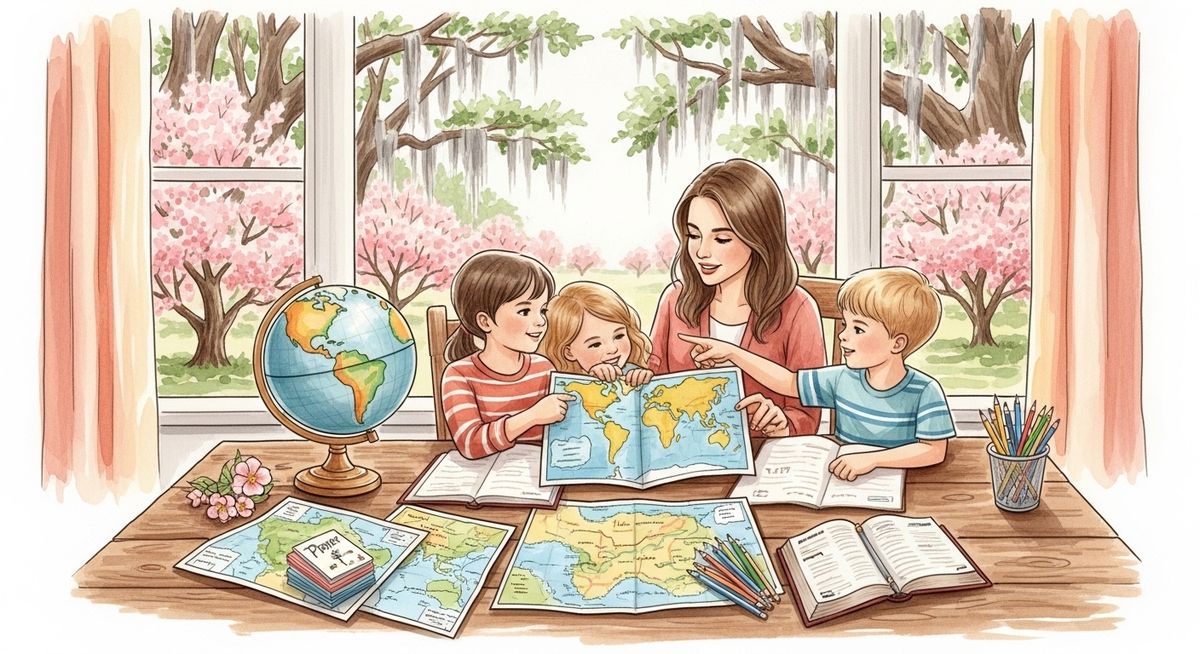
Inside, at the kitchen table, her three children sat with their schoolwork spread in front of them. Elijah, ten, was finishing a math worksheet. Naomi, seven, was copying vocabulary words in her neatest handwriting. And little Judah, five, was coloring a map of Africa, pressing his green crayon so hard it was starting to flatten on one side. A glass of sweet tea sweated on the counter. The ceiling fan turned slowly overhead.
Sarah set a laminated card on the table between the cereal box and the pencil cup. On it was a photograph of a woman in a bright orange headscarf, standing in front of a mud-brick house with a baby on her hip. The card read: “The Fulani of West Africa. Population: 40 million. Religion: Islam. Bible: portions in some dialects. Status: Unreached.”
“Before we start science,” Sarah said, “we are going to learn a name.”
That moment, quiet and unremarkable, is where missions education begins. Not with a textbook or a conference or a plane ticket. With a name, a photograph, and a family willing to look beyond their own red clay road and ask God what He is doing on the other side of the world.
This guide is for Georgia homeschool families who want to weave world missions into their daily curriculum. It covers Georgia’s legal requirements, a theological framework for why missions belongs in your school day, a practical weekly schedule, and Georgia-specific connections that bring global missions close to home. If you are building a broader homeschool missions curriculum, this is your Georgia chapter.
Georgia Homeschool Requirements
Georgia is one of the more straightforward states for homeschooling, but there are specific requirements to follow. Families must file a Declaration of Intent with the superintendent of their local school district by September 1 of each school year, or within thirty days of beginning homeschool instruction. The curriculum must cover reading, language arts, math, social studies, and science. Children must receive instruction for at least 180 days per year, with a minimum of 4.5 hours of instruction per day.
Georgia also requires an annual progress assessment. This can be a nationally standardized test administered by a qualified person, or it can be an evaluation by a certified teacher or other qualified professional. Parents must keep attendance records and submit monthly attendance reports to the local superintendent. While these requirements involve some paperwork, they are manageable and well-documented through the Georgia Department of Education.
The good news for missions-minded families is this: missions education fits directly into Georgia’s required subjects. Geography, world cultures, and global awareness fall under social studies. Missionary biographies, creative writing about people groups, and reading comprehension exercises satisfy language arts. Calculating distances, currency conversions, and population statistics cover math applications. And studying ecosystems, climates, and agriculture in unreached regions connects naturally to science. You are not adding an extra subject. You are enriching the ones you already teach.
Why Missions Belongs in Your Georgia Homeschool
There is a question that every Christian homeschool family has to answer, whether they realize it or not. It is not “What curriculum should we use?” or “How do we handle transcripts?” It is this: What is the purpose of the education we are giving our children?
If the answer is “to prepare them for college,” that is fine, but it is not big enough. If the answer is “to raise godly men and women,” that is closer, but it still needs a direction. Godly for what? Faithful toward what end?
The Bible gives a clear answer. God’s purpose in history, from Genesis 12 to Revelation 7, is the gathering of worshippers from every nation, tribe, people, and language. When God called Abraham, He did not say, “I will bless you so that you can be comfortable.” He said, “In you all the families of the earth shall be blessed” (Genesis 12:3). When Jesus gave His final command to His disciples, He did not say, “Stay in Jerusalem and build a nice community.” He said, “Go and make disciples of all nations” (Matthew 28:19). When John saw the culmination of all history in his Revelation, he did not see a single culture singing a single song. He saw a multitude “from every nation, from all tribes and peoples and languages, standing before the throne” (Revelation 7:9).
“Missions is not the ultimate goal of the church. Worship is. Missions exists because worship doesn’t.” John Piper wrote those words, and they have reoriented thousands of families toward a God-centered understanding of why the nations matter. If our children grow up loving God but never learning that God’s love extends to the Fulani and the Rohingya and the Shaikh and the Baloch, we have given them a Christ who is too small.
A missions-centered homeschool does not ignore reading or math or science. It gives those subjects a purpose beyond the test. Your child learns geography so she can find the Sindhi people on a map and pray for them by name. She reads biographies so she can see how ordinary men and women followed God into extraordinary obedience. She studies history so she can understand why 3.3 billion people still live with little or no access to the gospel. The curriculum does not change. The aim does.
A Weekly Missions Schedule for Georgia Families
One of the most common questions homeschool parents ask is, “Where does missions fit in our week?” The answer depends on your family’s rhythm, but here is a framework that works well for Georgia families following a Monday-through-Friday schedule. Adapt it freely. The goal is consistency, not perfection.
| Day | Time | Focus | Activity |
|---|---|---|---|
| Monday | 15 min | People Group Introduction | Read a people group profile. Find their location on the map. Say their name aloud. Each child writes or draws one thing they learned. Pray together. |
| Tuesday | 20 min | Geography and Culture | Map work: label the country, trace borders, mark major cities and rivers. Read about daily life, food, clothing, and homes. Discuss one cultural detail as a family. |
| Wednesday | 20 min | Scripture and Theology | Read a missions-related Bible passage. Discuss: What does this tell us about God’s heart for the nations? How does it connect to the people group we are studying this week? |
| Thursday | 30 min | Hands-On Activity | Cook a recipe from the region, complete a missions craft project, write a journal entry from the perspective of a child in the people group, or color a missions coloring page. |
| Friday | 15 min | Prayer and Review | Review what the family learned this week. Each child shares one thing that surprised them. Write prayer requests on a card and add it to the family prayer wall. Pray by name for the people group. |
This schedule totals about 100 minutes per week, spread across five days. Over a 36-week school year, your family will study 36 unreached people groups in meaningful depth. That is more than most adults learn in a lifetime.
For ready-made lesson frameworks in 15-minute, 30-minute, and 1-hour formats, see our printable missions lesson plans.
Georgia-Specific Connections: Missions Starts Close to Home
One of the advantages of homeschooling in Georgia is that global missions is not purely theoretical. The nations have come to Georgia. Your family can engage with the world without leaving your state.
Atlanta: A Global City
Atlanta is one of the largest refugee resettlement cities in the United States. Over the past two decades, thousands of families from Bhutan, Myanmar, the Democratic Republic of Congo, Syria, Afghanistan, and dozens of other nations have made Atlanta their home. These are not abstract statistics. These are real families, many of them from unreached or least-reached people groups, living in apartment complexes and neighborhoods across the metro area.
For your homeschool, this means that the people groups you study on Monday morning might live thirty minutes down the road. A unit on the Rohingya people of Myanmar becomes more urgent when you know that Rohingya families live in Clarkston, just east of Atlanta. A study of Afghan culture becomes personal when your children meet Afghan children at a local park or community center.
Clarkston: The Most Diverse Square Mile in America
Clarkston, a small city in DeKalb County just outside Atlanta, has been called “the most diverse square mile in America.” Since the 1990s, it has welcomed refugees from over 60 countries. Walking through Clarkston, you will hear Swahili, Burmese, Nepali, Arabic, Dari, Somali, and dozens of other languages. The grocery stores carry ingredients from five continents. The apartment complexes house families whose stories stretch from the highlands of Bhutan to the river plains of the Congo.
For Georgia homeschool families, Clarkston is a living classroom. Visit an international grocery store and have your children identify foods from countries you have studied. Attend a community event and listen to languages your family has prayed over. If your church partners with refugee ministry organizations in the area, your children can serve alongside the very people groups they are learning about.
This is what missions education looks like when it moves from the textbook to the sidewalk.
Missions Organizations Based in Georgia
Georgia is home to several major missions organizations, making it a natural hub for families who want to connect their homeschool studies with real mission work. The North American Mission Board is headquartered in Alpharetta. The International Mission Board maintains significant operations and training throughout the Southeast. Several smaller agencies and church planting networks also call Georgia home.
Some of these organizations offer family-friendly resources, prayer guides, and even tours of their facilities. A field trip to a missions organization headquarters can be one of the most impactful days in your homeschool year. Your children get to meet real people who do the work they have been praying about.
Savannah: History, Trade, and the Story of the Gospel
Savannah, Georgia’s oldest city, offers a different kind of missions connection. Founded in 1733 by James Oglethorpe, Savannah was one of the earliest points of contact between European settlers, enslaved Africans, and indigenous peoples in the American South. The city’s history includes some of the first organized efforts to share the gospel across cultural lines in the colonies. John Wesley, before he became the founder of Methodism, served as a minister in Savannah in the 1730s. His time there was complicated and often difficult, but it shaped his understanding of ministry and cross-cultural gospel work.
For a history unit, Savannah offers rich material. Your children can study the founding of the colony, the role of the port in global trade, the arrival of diverse peoples and religions, and the early missionary efforts that took root in the coastal lowcountry. Savannah’s historic district, with its squares and churches and cobblestone streets, brings the story to life in a way that a textbook cannot.
Georgia’s Agricultural Communities
In south Georgia and across the rural parts of the state, agriculture remains a major economic force. Peach orchards, pecan groves, cotton fields, poultry farms, and vegetable operations depend heavily on a workforce that includes many Hispanic and Latino families. Some of these families have lived in Georgia for generations. Others are recent arrivals. Many speak Spanish as their first language.
For homeschool families in rural Georgia, this is a missions connection that sits right next door. A study of the Quechua people of Peru or the Maya of Guatemala becomes more meaningful when your children realize that families from those very cultures may work in the fields they drive past every day. Missions is not only about people on the other side of the globe. Sometimes it is about the family in the next pew, or the workers at the farm stand, or the children at the county library who speak a language your children have never heard.
People Group Profiles to Explore
As you study these Georgia connections, consider pairing them with specific people group profiles:
- The Rohingya of Myanmar: Over a million Rohingya have been displaced from their homes. Thousands have resettled in the United States, including in the Atlanta area. They are a Muslim people group with virtually no access to the gospel. Learn more in our guide to praying for unreached people groups.
- The Bhutanese (Nepali-speaking): One of the largest refugee populations in the US, with significant communities in Georgia. Many are Hindu or Buddhist. Their resettlement story is one of resilience and displacement, and it offers rich material for geography, history, and prayer.
What Goes Inside a Wonder Letter
If you want a ready-made monthly resource that fits naturally into a Georgia homeschool week, Wonder Letters delivers a hand-illustrated letter about an unreached people group to your mailbox every month.
Each letter is written from a child’s perspective and includes cultural details, sensory descriptions of daily life, a QR code linking to bonus content, and prayer points for the featured people group. It is designed for children ages 5 to 12, and it works beautifully as a Thursday hands-on activity or a Monday morning introduction to the week’s people group study.
Here is what families use them for:
- Monday opener: Read the letter aloud as the introduction to the week’s people group. Find the country on the map. Discuss the cultural details.
- Writing prompt: Have older children write a response letter to the child in the Wonder Letter. What questions would they ask? What would they share about their own life in Georgia?
- Prayer focus: Use the prayer points from the letter as the family’s prayer focus for the week. Add the people group to your prayer wall.
- Art connection: The hand-illustrated style of each letter inspires children to create their own illustrated letters or coloring pages about the people group.
A monthly subscription is ten dollars. An annual subscription saves your family money and ensures a full year of people group studies arrives at your door. Fifty percent of every dollar goes to support work among unreached people groups through Global Serve International. Your subscription is itself a missions act.
Free Missions Resources for Georgia Homeschoolers
You do not need to spend a cent to begin teaching your children about God’s heart for the nations. Here are free resources to get started:
Lesson Plans and Curriculum Frameworks
- Printable Missions Lesson Plans: Ready-made frameworks in 15-minute, 30-minute, and 1-hour formats. Print them, grab a globe, and go.
- Homeschool Missions Curriculum: The complete guide to integrating missions across every subject, with unit study ideas and weekly schedules.
- Missions Through Geography Unit: A full geography unit built around unreached people groups, with printable maps and labeling activities.
Hands-On Activities
- Missions Coloring Pages: Free printable coloring pages featuring scenes from unreached people groups around the world.
- Christian Coloring Pages: Bible-themed coloring pages that pair well with missions Scripture passages.
- Missions Craft Projects: Hands-on craft ideas inspired by the cultures of unreached people groups. Flags, prayer chains, and cultural art projects.
- Around the World Cooking Activities: Recipes from the regions where unreached people groups live. Cook your way across the globe from your Georgia kitchen.
Prayer and Devotional Resources
- Missions Prayer Cards for Kids: Printable prayer cards with people group names, photos, and prayer points. Perfect for a family prayer wall.
- Praying for Unreached People Groups: A guide to praying specifically and faithfully for people who have never heard the gospel.
- Family Missions Devotional: A devotional guide that walks your family through Scripture passages about God’s heart for the nations.
- Missions Journaling for Kids: Journal prompts and frameworks for children to record what they learn and how they pray.
Reading and Study
- Missionary Heroes for Kids: Biographies of missionaries from William Carey to Amy Carmichael, written for children and families.
- What Are Unreached People Groups?: An introduction to the concept of unreached people groups, with statistics and maps.
- What Is the 10/40 Window?: An explanation of the geographic region where most unreached people groups live.
- Great Commission Bible Verses: A collection of Scripture passages about missions, organized by theme and suitable for memorization.
Building a Year-Long Missions Plan
A weekly rhythm is good. A year-long plan is better. Here is how to structure a full school year of missions education in your Georgia homeschool.
Quarter 1 (August through October): Foundations
Start the year by establishing the theological foundation. Why do missions matter? What does the Bible say about the nations? Spend the first two weeks studying key Scripture passages: Genesis 12:1-3, Psalm 67, Isaiah 49:6, Matthew 28:18-20, Acts 1:8, and Revelation 7:9-10. Use our Bible verses about missions collection as a reference.
Then begin your weekly people group studies. For the first quarter, focus on the 10/40 Window, the geographic band across North Africa, the Middle East, and Asia where most unreached people groups live. Study one people group per week: the Pashtun of Afghanistan, the Turks, the Berbers, the Sindhi, the Baloch. By October, your children will have a mental map of the world’s most unreached regions.
Quarter 2 (November through January): Missionary Heroes
Shift your focus to the men and women who gave their lives to take the gospel to the nations. Pair each missionary biography with the people group or region they served. Study William Carey and the peoples of India. Read about Hudson Taylor and the unreached interior of China. Learn about Amy Carmichael and the children of Dohnavur. Let your children see that ordinary people, some of them younger than your oldest child when they first felt the call, have done extraordinary things in the name of Christ.
This quarter also includes the holiday season, which is a natural time to talk about generosity, sacrifice, and what it means that God sent His Son to redeem people from every nation. A family Advent study focused on the global scope of Christ’s coming can be deeply meaningful.
Quarter 3 (February through April): Hands-On Engagement
This is the quarter for doing. Cook recipes from the nations you have studied. Complete craft projects inspired by unreached cultures. Write letters to missionaries. Create a family missions journal. If your family is in the Atlanta area, plan a field trip to Clarkston or to a missions organization headquarters. If you are in south Georgia, visit an international grocery store or attend a cultural festival.
This is also a good quarter to connect with your church’s missions efforts. Many Georgia churches participate in spring missions conferences. Bring your children. Let them hear real missionaries tell real stories. Let them put faces to the prayers they have been praying all year.
Quarter 4 (May through July): Review and Celebration
Spend the final weeks of the school year reviewing what your family has learned. Have each child create a presentation, a poster, a journal, a map, or a report on their favorite people group from the year. Celebrate what God has done in your family’s hearts. Pray over the summer for the people groups you have studied.
If you are part of a homeschool co-op, consider hosting a missions month event where each family presents a people group and brings a dish from that region. It is a powerful way to end the year and to invite other families into the vision.
Closing: Red Clay and the Ends of the Earth
There is something fitting about teaching missions from a Georgia kitchen table. Georgia is a state that knows about hospitality, about opening the front door and inviting people in. It is a state with deep roots in the Christian faith, with churches on every corner and Scripture on the lips of grandmothers and farmers and schoolteachers. And it is a state that, whether it knows it or not, has become a crossroads of the nations.
The Fulani woman on the laminated card in Sarah’s kitchen is not a stranger in an abstract sense. She is a woman made in the image of God, living in a place where the name of Jesus is barely whispered, raising children who have never heard the story that Sarah’s children hear every Sunday morning. The distance between Sarah’s kitchen table in Macon and that mud-brick house in West Africa is real, measured in miles and languages and oceans. But in God’s economy, it is also very small. Small enough to cross with a prayer. Small enough to bridge with a name spoken aloud at the breakfast table on a humid Georgia morning.
Your children do not need to wait until they are adults to care about the nations. They do not need a seminary degree or a passport or a missions agency budget. They need a map, a name, a Bible, and a family that believes what the Bible says: that God’s glory is meant to cover the earth as the waters cover the sea, and that every family, including yours, has a part to play.
Start this week. Print a people group profile. Set it on the table between the cereal box and the pencil cup. Say the name out loud. Pray. And watch what God does in the hearts of your children when they realize that the world is bigger than their red clay road, and that the God they worship is bigger still.
Explore Guides for Other States
Every state has homeschool families teaching their children about God’s heart for the nations. Browse our other state-specific guides, or return to the Homeschool Missions Curriculum hub for a complete framework.
- Homeschool Missions Curriculum for California
- Homeschool Missions Curriculum for Florida
- Homeschool Missions Curriculum for Illinois
- Homeschool Missions Curriculum for New York
- Homeschool Missions Curriculum for North Carolina
- Homeschool Missions Curriculum for Ohio
- Homeschool Missions Curriculum for Pennsylvania
- Homeschool Missions Curriculum for Texas
- Homeschool Missions Curriculum for Virginia
Brought to you by Wonder Letters
Monthly missions letters for families. 50% of profits support Global Serve International.