Homeschool Missions Curriculum for Illinois: A Family Guide
A Kitchen Table in Illinois
The furnace kicks on with a low hum, and heat rises through the floor vents, pushing back against a February morning that has settled over the prairie like a wool blanket. Outside, the flat land stretches in every direction, snow covering the fields in white silence. The sky is enormous here. You forget how enormous until you step outside and feel the wind come unbroken across a hundred miles of open ground.
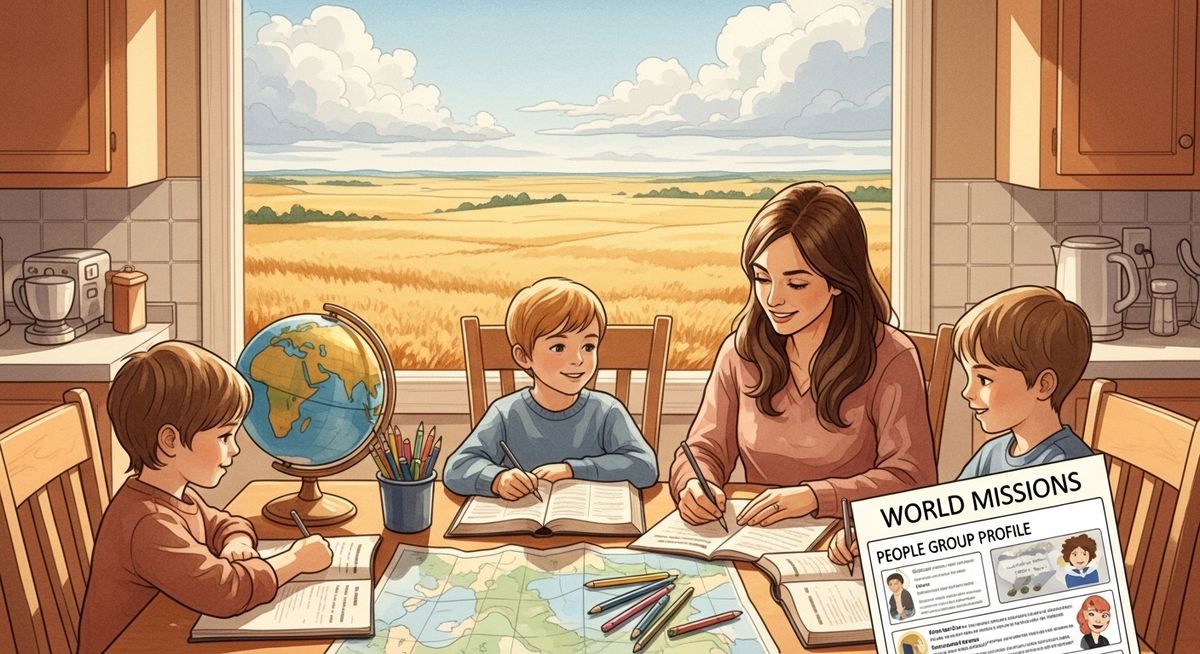
Inside, the kitchen table is warm. Coffee steam curls upward. A globe sits between a math workbook and a stack of colored pencils. One of your children is tracing the outline of the Sahara on a printed map, coloring it in with careful strokes of brown and gold. Another is reading aloud from a missionary biography, stumbling over the name of a Central Asian city. You help with the pronunciation, and then you pause together to pray for a people group that has never heard the gospel in their own language.
This is homeschool missions in Illinois. It does not require a plane ticket. It does not require a seminary degree. It requires a kitchen table, a willing heart, and the conviction that God is doing something breathtaking among the nations, and that your children were made to be part of it.
If you are an Illinois homeschool family looking to weave world missions into your daily learning, this guide is for you. We will walk through the legal landscape, the theological foundation, and the practical weekly rhythms that make missions a natural part of every subject you already teach.
Illinois Homeschool Requirements: What You Need to Know
Illinois is one of the most homeschool-friendly states in the country. The state treats homeschools as private schools under the Illinois School Code (105 ILCS 5/26-1). This means there is no registration requirement, no notification to the state, no standardized testing, and no portfolio review. You are not required to use a specific curriculum or follow a state-approved scope and sequence.
What Illinois does require is straightforward. Instruction must be provided in English in the branches of education taught to children of corresponding age and grade in the public schools. Those branches include language arts, mathematics, biological and physical sciences, social sciences, fine arts, health, and physical education. You have complete freedom in how you teach these subjects, what materials you use, and how you structure your school year.
This freedom is a gift, and it is also a responsibility. Because no one is checking your lesson plans, you have the opportunity to build a curriculum shaped by your deepest convictions about what matters most. For Christian families, that means building a curriculum shaped by Scripture and oriented toward the glory of God among all peoples. Missions is not an extracurricular add-on. It belongs at the center.
Why Missions Belongs in Your Illinois Homeschool
There is a thread running through the whole Bible, from Genesis to Revelation, and it is this: God intends to be known and worshiped by every tribe, every language, every people, and every nation. This is not a minor theme. It is the storyline. Abraham was blessed so that all the families of the earth would be blessed through him. Israel was set apart as a light to the nations. Jesus gave his final command not as a suggestion but as marching orders: go and make disciples of all nations.
When we teach our children about unreached people groups, we are not simply adding a geography elective. We are inviting them into the central narrative of Scripture. We are showing them that history has a direction, that God is moving with purpose, and that their lives are caught up in something far larger than grades and test scores and college applications.
“All the ends of the earth shall remember and turn to the LORD, and all the families of the nations shall worship before you.” (Psalm 22:27, ESV)
John Piper has written that missions exists because worship does not. Where the name of Christ has not been heard, where entire people groups live and die without ever encountering the gospel, there is a Christ-exalting urgency to the work of missions. That urgency is not meant for missionaries alone. It is meant for every believer, including the six-year-old sitting at your kitchen table in Peoria, the ten-year-old in your living room in Naperville, the teenager doing algebra in Springfield. When your children learn to pray for the Shaikh of Bangladesh or the Turkmens of Central Asia, they are participating in something eternal. They are learning that the world is bigger than their neighborhood, and that God’s heart is bigger still.
This is the theological foundation beneath everything that follows. The weekly schedules, the lesson plans, the coloring pages and prayer cards are all good and useful tools. But the tools serve a deeper purpose: forming children who see the nations the way God sees them, with compassion, with longing, and with hope.
A Weekly Missions Schedule for Illinois Homeschoolers
One of the most common questions we hear from homeschool parents is, “How do I fit missions into an already packed week?” The answer is simpler than you might expect. Missions does not need its own time slot. It integrates into subjects you are already teaching.
Here is a sample weekly rhythm that works for families at every level:
| Day | Time | Activity | Subject Integration |
|---|---|---|---|
| Monday | 15 min | Read a people group profile together. Locate the country on a map or globe. | Social Sciences, Geography |
| Tuesday | 15 min | Read a chapter from a missionary biography. Discuss vocabulary and themes. | Language Arts, History |
| Wednesday | 20 min | Complete a missions coloring page or draw the country’s flag. | Fine Arts |
| Thursday | 15 min | Write a prayer letter or journal entry about the people group. | Language Arts, Writing |
| Friday | 15 min | Pray together using a missions prayer card. Cook a simple recipe from the region. | Health, Social Sciences |
This schedule adds roughly seventy-five minutes to your week. That is less time than most families spend on a single field trip. And because each activity maps to a required Illinois subject area, you are not adding to your workload. You are enriching what you already do.
For families who want a more structured approach, our printable missions lesson plans provide complete frameworks in fifteen-minute, thirty-minute, and one-hour formats. Each lesson plan includes a Scripture reading, a people group profile, discussion questions, a hands-on activity, and a prayer prompt.
Illinois Connections: Missions Right Where You Live
One of the most remarkable things about teaching missions in Illinois is that the nations have already come to you. Illinois is home to one of the most ethnically and linguistically diverse populations in the United States, and that diversity creates opportunities for missions education that few other states can match.
Chicago: A World in One City
Chicago is one of the most diverse cities in America. It is home to large Polish, Mexican, Chinese, Indian, Filipino, Nigerian, Assyrian, and Bosnian communities, among dozens of others. For homeschool families, this is an extraordinary classroom.
Consider Devon Avenue on the north side of Chicago. Within a single mile, you will find Indian sari shops, Pakistani grocery stores, Bangladeshi restaurants, and Middle Eastern bakeries. Some have called it the most diverse street in the world. Walking down Devon Avenue with your children is not just a cultural experience. It is a living introduction to the peoples and languages that make up the 10/40 Window, the band of nations between ten and forty degrees north latitude where the vast majority of unreached people groups live.
You do not need to fly to South Asia to introduce your children to South Asian cultures, languages, and foods. You can drive to Devon Avenue. You can visit a Sikh gurdwara or a Hindu temple as a field trip and then come home to study what the Bible says about how God is at work among these communities. You can cook dal together and pray for the 200 million Shaikh people of South Asia, one of the largest unreached people groups in the world.
Chicagoland’s Missions Heritage
Illinois has deep roots in the history of global missions. D.L. Moody, one of the most influential evangelists of the nineteenth century, made Chicago his home and his base of operations. Moody Bible Institute, founded in 1886, has trained thousands of missionaries who have gone to every corner of the world. The legacy of Moody is woven into the spiritual fabric of Illinois, and it provides a rich starting point for teaching your children about the history of missions in their own state.
A field trip to Moody Bible Institute or Moody Church in Chicago can bring missions history to life. Your children can stand where Moody stood and learn about the Student Volunteer Movement, the great wave of young people in the late 1800s who committed their lives to taking the gospel to the nations. That movement began in part through Moody’s influence, and its echoes are still felt today.
Central and Southern Illinois
Beyond Chicago, the rest of Illinois offers its own missions connections. Central and southern Illinois are home to agricultural communities with growing Latino populations. Towns like Beardstown, Rantoul, and Mattoon have seen significant demographic shifts in recent decades as families from Mexico, Guatemala, Honduras, and other Latin American countries have settled to work in meatpacking plants, farms, and factories.
These communities present real, tangible opportunities for your family to practice hospitality and cross-cultural friendship. Invite a neighbor over for dinner. Learn some Spanish together as a family. Study the geography and history of Guatemala and then pray for the indigenous Maya peoples, many of whom have limited access to the Bible in their heart languages.
Champaign-Urbana: A University Town with a Global Footprint
The University of Illinois at Urbana-Champaign draws international students from over one hundred countries. For homeschool families in central Illinois, this means that representatives of nations from every continent are living within driving distance. Many universities host international student friendship programs, cultural festivals, and conversation partner opportunities. These are natural extensions of a missions curriculum, giving your children the chance to meet someone from the very people group they have been studying and praying for.
Imagine your daughter spending a month learning about the peoples of West Africa, coloring a map of Nigeria, reading about the Fulani people, and praying for them each morning. Then imagine her meeting a Nigerian graduate student at a campus coffee hour and hearing firsthand about the foods, festivals, and family life she has been reading about. That is the kind of education that stays with a child forever.
What to Study: People Groups and Missionary Heroes
If you are wondering where to begin, start with a single unreached people group. Our homeschool missions curriculum guide provides a complete framework for selecting, studying, and praying for a different people group each month.
Here are a few entry points:
For younger children (ages 4 to 7), begin with Christian coloring pages and simple stories. A coloring page of a family from North Africa or a child from Southeast Asia gives your little ones something concrete to hold while you read a short profile aloud. Follow it with a simple prayer: “God, please send workers to tell the Berber people about Jesus.”
For elementary-age children (ages 7 to 12), add missionary biographies and geography studies. Our missions books for kids page lists age-appropriate biographies of Hudson Taylor, Amy Carmichael, Gladys Aylward, and others. These stories are riveting on their own terms, full of adventure, danger, and faith. They also introduce children to the countries and cultures where these missionaries served, creating natural connections to geography, history, and social studies.
For older students (ages 12 and up), introduce the concept of unreached people groups more formally. Explore what a missionary is and how the definition has evolved over the centuries. Study the 10/40 Window. Research the history of Bible translation. Discuss the theology of missions in Romans 10:14-15 and the practical realities of cross-cultural communication. Older students can write research papers on specific people groups, create presentations for your co-op, or even begin corresponding with missionary families overseas.
Wonder Letters: A Monthly Missions Companion
If you are looking for a hands-on, ready-made resource that arrives at your door each month, Wonder Letters was built for families like yours.
Each month, your family receives a hand-illustrated letter written from the perspective of a child living among an unreached people group. The letter includes cultural details, a QR code linking to bonus content, activities, and a prayer guide. It is designed for children ages 5 to 12, but families tell us that everyone from toddlers to grandparents gathers around to read the letter together.
Wonder Letters integrates naturally into any homeschool schedule. Use the letter as your Monday people-group reading. Let the activities fill your Wednesday fine arts block. Use the prayer guide on Friday. One resource, multiple subject connections, delivered to your mailbox every month.
Fifty percent of every dollar goes directly to support work among unreached people groups through Global Serve International. When your family subscribes, you are not just learning about missions. You are participating in it.
Subscribe monthly for ten dollars or save with an annual subscription.
Free Resources to Get Started Today
You do not need to spend a dime to begin integrating missions into your Illinois homeschool. Here are free resources available right now:
Our Homeschool Missions Curriculum hub is the best place to start. It provides complete weekly and monthly frameworks, suggested book lists, and guidance on how to teach missions across every subject area. Whether you have fifteen minutes a week or an hour a day, there is a plan that fits your family.
For daily or weekly lesson structure, our Printable Missions Lesson Plans offer downloadable, print-ready plans organized by age group. Each plan includes Scripture, a people group profile, discussion questions, a hands-on activity, and a prayer prompt. Print them, put them in a binder, and you have a year of missions curriculum ready to go.
If your children are visual learners, our Christian Coloring Pages are a wonderful entry point. Each page features a scene connected to a people group or a biblical missions theme. Coloring is not just for young children, either. We have seen middle schoolers and even parents sit down with these pages and find them surprisingly reflective and calming.
Prayer is the heartbeat of missions, and our Missions Prayer Cards make it easy to pray specifically and consistently for unreached people groups. Print a set, keep them on the kitchen table, and pull one out each morning at breakfast. Over the course of a year, your family will have prayed for dozens of people groups by name.
For churches and co-ops planning summer programs, our VBS Missions Curriculum provides a complete five-day framework centered on unreached people groups. It works beautifully for homeschool co-ops that want to do a week-long missions intensive together.
And for families who love to read aloud, our Missions Books for Kids page curates the best missionary biographies, picture books, and chapter books organized by age and reading level.
Building a Missions Culture in Your Home
The goal of missions education is not to produce children who know facts about foreign countries. The goal is to form children whose hearts break for what breaks the heart of God. That kind of formation does not happen through curriculum alone. It happens through culture, the culture of your home.
Here are a few practices that Illinois homeschool families have found meaningful:
Pray at mealtimes for a specific people group. Keep a prayer card on the table. Rotate to a new group each week. Over time, your children will develop a mental map of the world that is oriented not by politics or economics but by the progress of the gospel.
Cook meals from the regions you study. When you are learning about the peoples of the Middle East, make hummus and flatbread together. When you study West Africa, try jollof rice. Food is one of the most accessible and memorable ways to connect with another culture. And for Illinois families, many of the ingredients are available at international grocery stores in Chicago, the suburbs, or even smaller cities like Bloomington and Rockford.
Display a world map in your school space. Mark the countries you have studied. Add photos, flags, and prayer requests. Over the course of a year, your map becomes a visual testimony of what God is doing around the world, and your family becomes a part of it.
Write letters to missionary families. Many missionaries report that receiving mail from children in the United States is one of the most encouraging parts of their week. Your child’s handwritten note, complete with crayon drawings and misspelled words, carries more weight than you might imagine.
Visit a local church that worships in another language. Chicago alone has churches that worship in Spanish, Korean, Mandarin, Arabic, Amharic, Tagalog, Polish, and many other languages. Attending a service in another language, even if you understand nothing, gives your children a tangible experience of the global body of Christ. It also reinforces the truth that worship is not an American invention. It belongs to every tribe and tongue.
A Word of Encouragement
If you are reading this and feeling overwhelmed, take a breath. You do not need to overhaul your entire curriculum. You do not need to become an expert in missiology. You do not need to book a flight to the other side of the world.
Start with fifteen minutes. Print one people group profile. Read it together. Find the country on a globe. Pray one prayer. That is enough for today.
The beauty of homeschool missions is that it grows organically. One prayer leads to curiosity. Curiosity leads to a book. A book leads to a conversation. A conversation leads to a friendship. A friendship leads to love. And love, the kind of love that the Spirit of God produces in the hearts of his people, is the engine of global missions.
Your kitchen table in Illinois is a sending station. The flat prairie outside your window stretches toward a horizon you cannot see, but God sees it. He sees the Uyghurs of western China. He sees the Somali diaspora in Minneapolis and Chicago. He sees the Quechua farmers in the Andes and the Rohingya refugees in Bangladesh. He sees them, and he is calling your family to see them too.
Start today. Start small. Start with wonder.
Explore Guides for Other States
Every state has homeschool families teaching their children about God’s heart for the nations. Browse our other state-specific guides, or return to the Homeschool Missions Curriculum hub for a complete framework.
- Homeschool Missions Curriculum for California
- Homeschool Missions Curriculum for Florida
- Homeschool Missions Curriculum for Georgia
- Homeschool Missions Curriculum for New York
- Homeschool Missions Curriculum for North Carolina
- Homeschool Missions Curriculum for Ohio
- Homeschool Missions Curriculum for Pennsylvania
- Homeschool Missions Curriculum for Texas
- Homeschool Missions Curriculum for Virginia
Brought to you by Wonder Letters
Monthly missions letters for families. 50% of profits support Global Serve International.