Homeschool Missions Curriculum for New York: A Family Guide
A Kitchen Table in New York
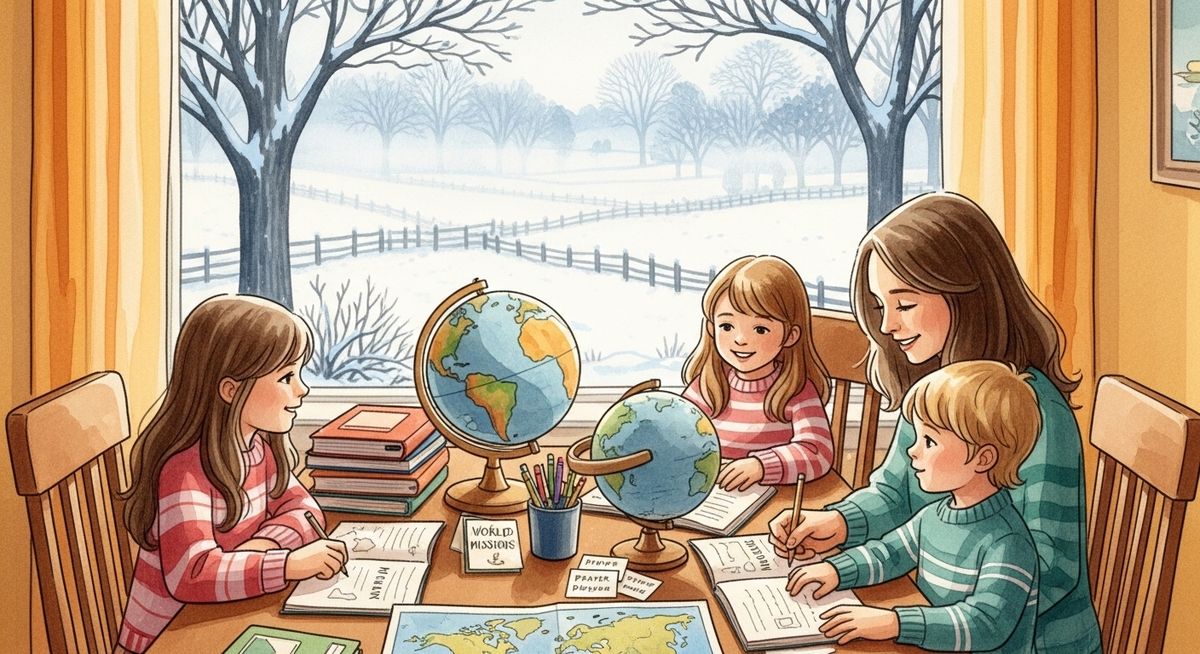
The snow came early this year. By seven in the morning the fields north of the Mohawk Valley were blanketed white, and the kitchen windows had fogged over from the warmth inside. A mother set a pot of oatmeal on the stove and spread a hand-drawn map across the table. Her three children, still in pajamas, leaned in to find the country she had circled in red marker the night before. It was Bangladesh. They had never heard of the Shaikh people who live there, and they certainly could not have guessed that more than 130 million of them have no access to the gospel. But by the end of breakfast, they would know. They would have colored a flag, located the Ganges River delta, and prayed by name for a people group most churches in America have never mentioned.
That is what missions education looks like in a New York homeschool. It does not require a dedicated curriculum or an expensive subscription box, though those things can help. It requires a willingness to let the nations interrupt your morning routine. It requires a parent who believes that God’s purposes extend beyond the borders of their own town, their own state, their own comfort.
New York is a wonderful place to homeschool with a missions focus. Whether your family lives in a Brooklyn brownstone, a Rochester suburb, or a farmhouse along the Finger Lakes, you are surrounded by reminders that God has brought the nations to your doorstep. The question is not whether your children will encounter the world. The question is whether they will encounter the world through the lens of Scripture, with hearts shaped by the Great Commission. This guide will help you do exactly that, while meeting every one of New York’s homeschool requirements along the way.
If you are just getting started, our comprehensive homeschool missions curriculum guide provides the full framework. This article focuses on what makes New York unique, and how your family can take advantage of it.
Understanding New York Homeschool Requirements
New York is one of the most regulated states in the country for homeschooling. That can feel overwhelming at first. But the good news is that missions education, done well, naturally satisfies many of the required subjects. Let us walk through what the state expects, and then show you how missions covers it.
Every homeschooling family in New York must file an Individualized Home Instruction Plan (IHIP) with their local school district by July 1 of each year (or within 14 days of beginning homeschooling, if starting mid-year). The IHIP must include the child’s name, age, and grade level; a list of the syllabi, curriculum materials, or textbooks to be used in each required subject; and the dates of the four quarterly reports you will submit throughout the year. In addition, New York requires an annual assessment. For most grades, this means a standardized test in every other year and a written narrative evaluation from a certified teacher or homeschool peer review panel in the alternate years.
The required subjects vary by grade level. For grades one through six, New York mandates arithmetic, reading, spelling, writing, English, geography, United States history, science, health education, music, visual arts, physical education, and, where applicable, bilingual education and library skills. Starting in grades seven and eight, the state adds career development and citizenship. At the high school level, the list expands further to include specific course requirements in math, science, English, social studies, and the arts.
Here is the encouraging part: a well-designed missions curriculum touches nearly every one of these subjects. Geography is obvious. When your children study the Fulani people of West Africa, they are learning about the Sahel region, climate patterns, and migration routes. That is geography. When they read a missionary biography of Hudson Taylor, they are practicing reading comprehension and building vocabulary. That is English language arts. When they calculate the distance between New York City and Dhaka, or convert currencies, or graph the population of an unreached people group over time, that is arithmetic. When they learn a traditional song from the culture they are studying, that is music. When they color a people group profile or sketch a map, that is visual arts. When they discuss what it means to love your neighbor across cultural boundaries, that is citizenship. Missions education is not an add-on to your required subjects. It is a thread that runs through all of them.
Why Missions Belongs in Your New York Homeschool
There is a temptation in Christian homeschooling to treat missions as a special topic, something you cover during a week in November or a Wednesday night church program. But Scripture does not present the global purposes of God as a side note. The Bible is a missions book from beginning to end. God’s promise to Abraham in Genesis 12:3, that through his offspring all the families of the earth would be blessed, is not a footnote. It is the storyline. And every family that opens the Bible together has the opportunity to trace that storyline from Genesis to Revelation, from promise to fulfillment, from Abraham to the Lamb who was slain for every tribe and tongue and people and nation.
John Piper has written extensively about the relationship between worship and missions, and his words are worth sitting with:
“Missions is not the ultimate goal of the church. Worship is. Missions exists because worship doesn’t. When this age is over, and the countless millions of the redeemed fall on their faces before the throne of God, missions will be no more. It is a temporary necessity. But worship abides forever.”
That conviction reshapes how we teach. We are not simply educating our children about distant cultures for the sake of cultural literacy, though that has value. We are inviting them into the grandest story ever told: the story of a God who is gathering worshippers from every people group on earth. When your children learn about the Shaikh of Bangladesh or the Berber of North Africa or the Tibetan Buddhist monks in the Himalayas, they are learning about people whom God loves, people for whom Christ died, people who have not yet heard. That knowledge should produce something in us. It should produce prayer. It should produce generosity. It should produce a willingness to go, or to send, or to welcome the stranger who has come to live next door.
Psalm 96:3 says, “Declare his glory among the nations, his marvelous works among all the peoples.” That verse is not addressed only to professional missionaries. It is addressed to the people of God. It is addressed to your family, sitting around your kitchen table in New York, with oatmeal on the stove and a map spread open. Your children can declare his glory among the nations right now, today, by learning, by praying, by caring. And as they grow, the seeds you plant in these early years will bear fruit you cannot yet imagine.
This is why we built our homeschool missions curriculum framework. Not because missions is a nice supplement to your school day, but because it belongs at the center. The Great Commission is not an elective.
A Weekly Missions Schedule for New York Families
One of the most common questions we hear from New York homeschool parents is, “How do I fit missions into an already packed schedule?” The answer is simpler than you think. You do not need to overhaul your curriculum. You need 15 to 60 minutes per week, depending on how deep you want to go. Here is a sample weekly schedule you can adapt to your family’s rhythm.
| Day | Time | Activity | NY Subjects Covered |
|---|---|---|---|
| Monday | 15 min | Read a people group profile together. Locate the country on a map. Discuss one key fact about the culture. | Geography, Reading, Social Studies |
| Tuesday | 15 min | Read a missionary biography excerpt. Discuss the missionary’s motivations and challenges. | Reading, English, History, Citizenship |
| Wednesday | 20 min | Hands-on activity: color a flag, sketch a map, try a recipe from the culture, or learn a greeting in a new language. | Visual Arts, Music, Health (if food-related) |
| Thursday | 15 min | Math connection: calculate distances, convert currencies, graph population data, or compare climate statistics. | Arithmetic, Science, Geography |
| Friday | 15 min | Family prayer time. Use a missions prayer card to pray for the people group you studied this week. Write in a prayer journal. | Writing, Spelling |
That is roughly 80 minutes per week. Over the course of a school year, your children will study 36 or more people groups, read dozens of missionary stories, and develop a habit of prayer for the nations that will stay with them for the rest of their lives.
For families who want a shorter commitment, our printable missions lesson plans offer a 15-minute weekly format that covers one people group per session. For families who want to go deeper, the one-hour format adds research projects, creative writing, and extended prayer.
New York’s Unique Advantage: The Nations at Your Doorstep
Here is something most curriculum guides will not tell you: New York is one of the best places in the world to study missions, because the nations have already come to you.
New York City: 800 Languages and Counting
New York City is the most linguistically diverse city on the planet. Researchers have documented more than 800 languages spoken within the five boroughs. That is not a typo. Eight hundred. Queens alone has been called the most ethnically diverse urban area in the world. Within a single subway ride, your family can hear Mandarin, Arabic, Bengali, Haitian Creole, Yoruba, Uzbek, and dozens of languages you may never have encountered before.
This is not just a fun fact for geography class. It is a theological reality. God has brought the nations to New York. Many of these language communities include people from unreached or least-reached people groups. The Bangladeshi community in Jackson Heights includes Shaikh Muslims who have never heard the gospel clearly explained. The Tibetan community in Woodside includes Buddhists from one of the most spiritually isolated regions on earth. The West African communities in the Bronx include Fulani and Hausa Muslims whose families back home have almost no access to Scripture in their own language.
For your homeschool, this means something extraordinary. You do not have to imagine what it looks like to encounter an unreached people group. You can visit a neighborhood, eat at a restaurant, listen to a language, and begin to understand the real human faces behind the statistics. Take your children to the Ganesh Temple in Flushing. Walk through the Tibetan shops on Roosevelt Avenue. Visit the West African market on Jerome Avenue in the Bronx. These are not tourist activities. They are field trips in the most profound sense: opportunities to see the world God loves, and to ask your children, “How can we pray for these neighbors?”
Upstate New York: Refugee Communities
If your family lives outside the city, you are not excluded from this reality. Buffalo, Rochester, Syracuse, and Utica have become major refugee resettlement centers over the past two decades. Buffalo’s West Side is home to significant Burmese, Bhutanese, Karen, Somali, and Iraqi communities. Rochester has welcomed large numbers of Bhutanese and Somali refugees. Utica has been called the “Town that Loves Refugees” and is home to Bosnian, Burmese, Karen, and Somali families, among others.
These communities include people from some of the most unreached regions on earth. The Karen people of Myanmar, many of whom are Christian, have a remarkable story of faith that stretches back to the early 1800s and the work of Adoniram Judson. The Somali Bantu community includes Muslims who have had very little exposure to the gospel. When your children study these people groups in your curriculum, they may discover that some of these same families live just down the road.
The Hudson Valley and Beyond
Even in more rural parts of the state, the nations are present. The Hudson Valley and the agricultural regions of western New York are home to growing Haitian and Latin American communities, many of whom work in agriculture and food processing. Long Island has significant Salvadoran, Guatemalan, and South Asian populations. And of course, New York City is home to the United Nations, which makes the concept of “a gateway to the nations” more than a metaphor. If your family can make a trip to the city, the UN Visitors Centre offers educational programs that pair well with a study of world missions and global geography.
For people group profiles you can use in your homeschool, visit our resources on what a missionary is and explore our growing library of Christian coloring pages that introduce children to cultures around the world.
Connecting Missions to Your Existing Curriculum
You do not need to abandon whatever curriculum you are already using. Missions education layers on top of any framework. Here are some practical ways to integrate it.
Language Arts and Reading
Missionary biographies are some of the most compelling stories in Christian history. For younger children, picture books about Amy Carmichael, Gladys Aylward, or Jim and Elisabeth Elliot introduce themes of courage, sacrifice, and God’s faithfulness. For older students, full-length biographies by Janet and Geoff Benge, or the classic “From Jerusalem to Irian Jaya” by Ruth Tucker, provide rich material for book reports, narration, and discussion. Our guide to missions books for kids has age-appropriate recommendations for every reading level.
Writing assignments flow naturally from missions study. A child who has learned about the Berber people of North Africa can write a journal entry from the perspective of a Berber child. A teenager who has studied the history of Bible translation can write a persuasive essay about why every people group deserves Scripture in their own language. These are not generic writing prompts. They are invitations to think deeply about the world and to practice empathy through the written word.
Social Studies and Geography
This is where missions education shines. Every people group profile is a geography lesson. Every missionary biography is a history lesson. Every discussion about cultural differences and the ethics of cross-cultural engagement is a citizenship lesson. New York’s social studies requirements for grades seven and eight include career development and citizenship. A study of missions naturally addresses both: it introduces children to careers in cross-cultural work, translation, medicine, and education, and it raises questions about what it means to be a good neighbor in a globalized world.
Keep a world map on your wall and mark each people group you study with a pin or a sticker. By the end of the year, your children will have a visual record of how far their prayers have traveled.
Science and Math
You might not immediately think of missions as a science subject, but consider this: when you study a people group, you study their environment. The Sahel region of West Africa teaches your children about desertification, climate patterns, and water scarcity. The Himalayan plateau teaches them about altitude, weather systems, and biodiversity. The river deltas of Bangladesh teach them about flooding, agriculture, and the science of land formation.
Math connections are equally natural. Calculate the distance from your home in New York to the country you are studying. Convert the local currency. Compare population growth rates. Graph the percentage of a country that has access to clean water, or to Scripture in their language. These are real-world math problems with real-world significance.
Music and Visual Arts
New York requires music and visual arts instruction for grades one through six. Missions study gives you a world of material. Learn a worship song in Swahili. Listen to traditional instruments from Central Asia. Study the textile patterns of the Hmong people and create your own fabric art. Sketch a mosque, a Buddhist temple, or a village church made of mud bricks. These activities satisfy your arts requirements while expanding your children’s understanding of how people around the world express beauty, meaning, and worship.
Our Christian coloring pages are designed specifically for this purpose. Each page introduces a cultural element, a Scripture verse, or a missionary story that your children can engage with through art.
Wonder Letters: A Monthly Missions Delivery
If you want a hands-on, ready-made missions supplement for your homeschool, Wonder Letters is designed for families like yours. Each month, we send a hand-illustrated letter to your mailbox written from the perspective of a child in an unreached people group. The letter includes cultural details, activities, a QR code linking to bonus content, and a prayer guide. It is designed for children ages four through twelve, though many families read it aloud together regardless of age.
Wonder Letters is used in homeschool co-ops, Sunday school classes, and family devotion times across the United States and Canada. Fifty percent of every dollar goes directly to support work among unreached people groups through Global Serve International.
You can subscribe monthly for ten dollars or save with an annual subscription. Each letter arrives in your mailbox ready to use, with no prep required on your part.
For New York families, Wonder Letters pairs perfectly with the local connections described above. When a letter features a people group from South Asia, take your children to Jackson Heights and walk through the neighborhood. When a letter features a West African people group, visit the markets in the Bronx. The combination of a physical letter in hand and a real community down the road makes missions education come alive in a way that textbooks alone cannot.
Free Resources to Get Started This Week
You do not need to wait for a curriculum to arrive in the mail. You can begin missions education today with free resources available right now.
Our printable missions lesson plans give you a complete framework for weekly lessons in 15-minute, 30-minute, and one-hour formats. Each lesson plan includes a people group profile, discussion questions, a hands-on activity, and a prayer prompt.
If your children are younger, start with our Christian coloring pages. Each page introduces a culture, a Scripture verse, or a missionary story through art. Print them out, hand your children some colored pencils, and talk about what they see.
For families with older children, our article on what is a missionary provides a thorough, Scripture-grounded exploration of what it means to be sent by God. It is a wonderful starting point for family discussions about calling, vocation, and the Great Commission.
Missions prayer cards are another simple entry point. Print a set, place them on your kitchen table, and pray for one people group each day. Over the course of a month, your family will have prayed for 30 different groups of people who desperately need the gospel.
If your church or co-op is planning a Vacation Bible School, our VBS missions curriculum provides a complete five-day framework centered on unreached people groups. It includes games, crafts, stories, and Scripture memory activities, all designed to give children a vision for the nations.
And for a curated list of the best missionary biographies, picture books, and chapter books for children, visit our guide to missions books for kids.
A Final Word to New York Families
Homeschooling in New York is not easy. The paperwork is real. The quarterly reports are real. The annual assessments are real. There are days when the weight of it all makes you wonder whether you are doing enough, whether your children are learning enough, whether the sacrifice is worth it.
Let me offer you this encouragement. When you teach your children about the nations, you are doing something that no standardized test can measure. You are shaping their hearts. You are forming their vision of God. You are giving them a category for the billions of people on this planet who have never heard the name of Jesus. That is not a small thing. That is an eternal thing.
The snow will melt in the Mohawk Valley. The seasons will turn. Your children will grow. And one day, years from now, they will remember sitting at that kitchen table with oatmeal and a map. They will remember the Shaikh people of Bangladesh, the Fulani of West Africa, the Karen of Myanmar. They will remember praying. And whether God calls them to stay in New York or to go to the ends of the earth, they will carry with them a love for the nations that began in your home.
Start small. Start this week. Fifteen minutes and a prayer card. The God who said, “Declare his glory among the nations,” will meet you there.
Explore Guides for Other States
Every state has homeschool families teaching their children about God’s heart for the nations. Browse our other state-specific guides, or return to the Homeschool Missions Curriculum hub for a complete framework.
- Homeschool Missions Curriculum for California
- Homeschool Missions Curriculum for Florida
- Homeschool Missions Curriculum for Georgia
- Homeschool Missions Curriculum for Illinois
- Homeschool Missions Curriculum for North Carolina
- Homeschool Missions Curriculum for Ohio
- Homeschool Missions Curriculum for Pennsylvania
- Homeschool Missions Curriculum for Texas
- Homeschool Missions Curriculum for Virginia
Brought to you by Wonder Letters
Monthly missions letters for families. 50% of profits support Global Serve International.