Homeschool Missions Curriculum for North Carolina: A Family Guide
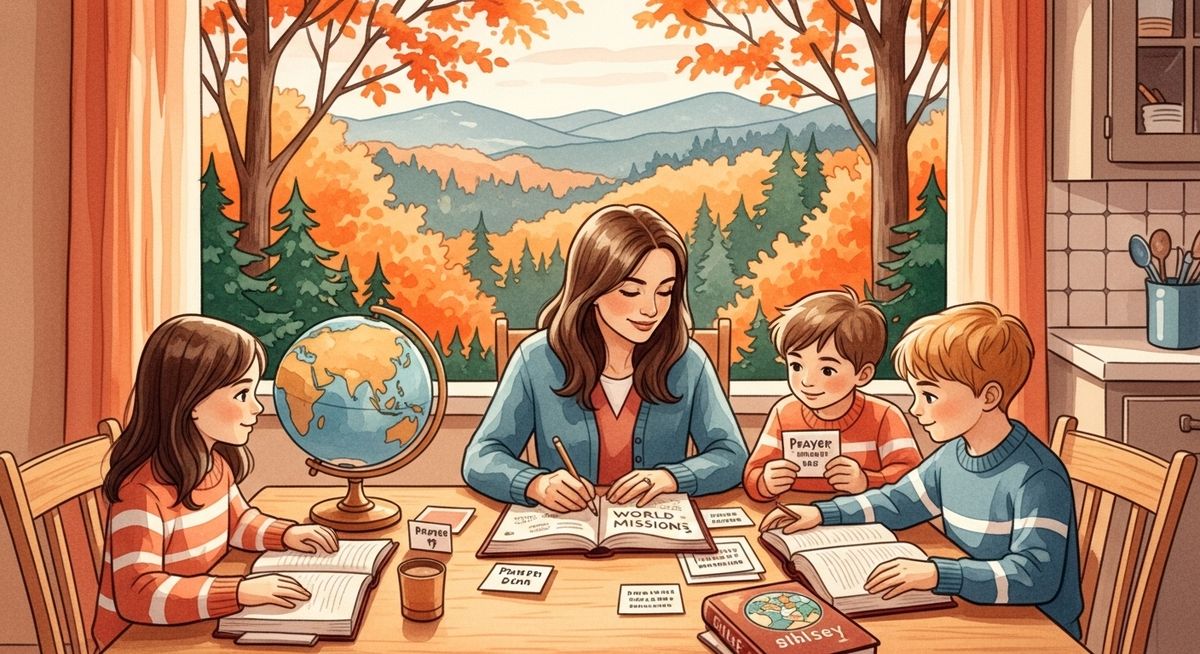
The morning fog sat low over the Piedmont, clinging to the red clay and the line of loblolly pines behind the house. Inside, the kitchen smelled like coffee and cinnamon toast. A globe sat on the table between a stack of math workbooks and a jar of colored pencils. Emma, nine years old, was tracing her finger across Central Asia, trying to pronounce “Uzbekistan” without stumbling over the z. Her younger brother, Caleb, was coloring a map of North Africa. Their mother, Sarah, stood at the counter with her Bible open to Acts 17, reading aloud about Paul in Athens while the dog slept under the table and the washing machine hummed from the hall.
This is what missions education looks like in a North Carolina homeschool. It does not require a plane ticket or a seminary degree or a curriculum that costs three hundred dollars. It requires a table, a globe, a Bible, and a willingness to say the names of people groups that most American Christians have never heard of.
North Carolina is home to more than 110,000 homeschooled students, one of the largest homeschool populations in the country. The state’s relatively friendly legal framework gives families the freedom to shape education around their deepest convictions. For Christian families who believe that God’s heart beats for every nation, tribe, people, and language, that freedom is an extraordinary gift. It means that missions is not something you squeeze into Sunday morning between the offering and the benediction. It is something you can build an entire education around, five days a week, at your own kitchen table.
This guide is written for North Carolina homeschool families who want to weave world missions into their daily learning. It covers the state’s legal requirements, a practical weekly schedule, connections to the diverse communities already in your state, and a library of free resources to get you started this week.
North Carolina Homeschool Requirements
North Carolina is considered one of the more homeschool-friendly states in the country. The legal framework is straightforward, and it gives families substantial freedom in choosing curriculum, methods, and content.
Here is what the state requires:
Registration. You must file a Notice of Intent with the Division of Non-Public Education (DNPE), which operates under the Office of the Governor. This is a simple online form. You file it once when you begin homeschooling and do not need to re-file annually unless your information changes.
Attendance. You must maintain attendance records for a minimum of nine calendar months per year. The state does not specify how many hours per day or days per week you must teach. It requires records, not a rigid schedule.
Testing. You must administer a nationally standardized test each year. You choose the test. You administer it yourself or hire someone to do so. You keep the results on file in your home. You do not submit scores to the state. The state does not review them. They are for your records.
Diploma. When your child finishes high school, you, the parent, issue the diploma. North Carolina recognizes homeschool diplomas for community college and university admission.
Curriculum. Here is the critical point for our purposes: North Carolina does not mandate specific subjects. The state does not tell you what to teach. It requires that you operate a home school in which instruction is provided on a regular schedule, but it does not prescribe content areas, textbook lists, or curriculum standards. This means you have complete freedom to include missions as a core subject, whether you integrate it into geography, history, reading, and social studies, or whether you give it a dedicated time block every week.
That freedom is not incidental. It is the reason North Carolina homeschool families are uniquely positioned to raise children who know the world, not as an abstraction on a test, but as a place filled with real people who need the gospel.
Why Missions Belongs in Your North Carolina Homeschool
There is a theological argument for missions education, and it begins not with strategy or cultural awareness but with the character of God himself.
God is a sending God. He sent Abraham out of Ur. He sent Moses back to Egypt. He sent Jonah to Nineveh, reluctantly but effectively. He sent his own Son into the world, not to be served but to serve and to give his life as a ransom for many (Mark 10:45). And after the resurrection, the Son sent his followers to the ends of the earth. “As the Father has sent me, even so I am sending you” (John 20:21).
This is not a footnote in the biblical narrative. It is the narrative. From Genesis 12, where God tells Abraham that through him all the families of the earth will be blessed, to Revelation 7:9, where a great multitude from every nation and tribe and language stands before the throne, the Bible is a missions book. Every page moves toward the same destination: the glory of God among all peoples.
“Missions is not the ultimate goal of the church. Worship is. Missions exists because worship doesn’t.” John Piper wrote those words in Let the Nations Be Glad, and they have shaped a generation of Christians who understand that the Great Commission is not a departmental program. It is the heartbeat of a God who will not rest until his name is praised in every language on earth.
If that is true, and Scripture says it is, then a Christian education that ignores missions is an incomplete education. It is like teaching music without rhythm or science without observation. The Great Commission is not an elective. It is the frame that holds every other subject in place. Geography teaches your child where the nations are. History teaches how God has moved among them. Language arts gives your child the tools to tell their stories. Science reveals the world God made for them to inhabit. Math quantifies the need: 3.29 billion people live in unreached people groups. That is not a statistic. That is a prayer list.
North Carolina homeschool families have the legal freedom, the schedule flexibility, and the kitchen table theology to make missions the spine of their children’s education. The question is not whether it fits. The question is whether we will use the freedom we have been given.
A Weekly Missions Schedule for North Carolina Families
The following schedule integrates missions into a typical homeschool week without replacing your existing curriculum. It adds to what you are already doing, layering missions onto subjects you already teach.
| Day | Time | Activity | Details |
|---|---|---|---|
| Monday | 15 min | People Group Introduction | Name, location, population, religion, language. Find them on the globe. Say their name aloud. Read three facts from a printable lesson card. |
| Tuesday | 15-20 min | Missionary Biography Reading | Read a chapter from a missionary biography or a profile from our missionary heroes series. |
| Wednesday | 30 min | Cultural Deep Dive | Study daily life, food, clothing, and traditions of the week’s people group. Connect to a Scripture passage. Write a journal reflection. |
| Thursday | 20-30 min | Hands-On Activity | Cook a recipe from the region, complete a missions craft project, or color a missions coloring page. |
| Friday | 30-45 min | Prayer, Review, and Response | Review the week’s people group. Write a prayer in a missions journal. Pray together as a family. Add a pin to your wall map. |
This rhythm produces five touchpoints per week on a single people group. By Friday, the name that was unfamiliar on Monday has become a person your child knows, prays for, and remembers. Over a thirty-six-week school year, your family will study thirty-six unreached people groups. That is more than most adults learn in a lifetime.
For ready-made lesson frameworks in 15-minute, 30-minute, and 1-hour formats, see our printable missions lesson plans.
North Carolina Connections: Missions in Your Own Backyard
One of the most powerful things about missions education is that it does not have to remain abstract. North Carolina is home to vibrant international communities, deep historical roots in global missions, and geographic diversity that makes cross-cultural learning tangible. Here are five connections you can make without leaving your state.
Charlotte: A City of Nations
Charlotte is one of the fastest-growing cities in the Southeast, and its growth has brought the world to its doorstep. The city is home to large Latin American, Vietnamese, and Hmong communities. The Hmong people, originally from the mountain regions of Laos, Vietnam, and southern China, are one of the most significant refugee communities in the Carolinas. Many Hmong families arrived after the Vietnam War, and their culture, language, and spiritual traditions are distinct and rich.
For a homeschool family in or near Charlotte, the Hmong community is not a lesson on a page. They are neighbors. You can visit an Asian grocery store on Central Avenue, taste lemongrass and galangal, see Hmong textile patterns in person, and learn about a people group that straddles the line between reached and unreached. Many Hmong have become Christians, but traditional Hmong animism persists in communities around the world, particularly in Southeast Asia, where millions of Hmong have never heard the gospel.
Use Charlotte as a bridge. Study the Hmong people at your kitchen table, then go meet them at a cultural festival or a local church plant. Missions is not only about faraway places. Sometimes it is about the family two miles from your house.
The Research Triangle: A Global University Community
Raleigh, Durham, and Chapel Hill form one of the most internationally diverse academic corridors in the South. The universities and research institutions in the Triangle draw students and scholars from South Asia, East Africa, the Middle East, and East Asia. Indian, Pakistani, Bangladeshi, Ethiopian, Eritrean, and Chinese communities are well represented.
For homeschool families in the Triangle, this is an opportunity to study unreached people groups and then encounter people from those same regions at a local restaurant, a community event, or a university international student gathering. Many churches in the Triangle run international student ministries that welcome families. Your children can practice hospitality, learn to pronounce names correctly, hear accents they have only imagined, and put a face on the people groups they have been praying for.
The South Asian communities in the Triangle also provide a natural connection to the 10/40 Window, the geographic belt across North Africa, the Middle East, and Asia where the vast majority of unreached people groups live. Studying India at the kitchen table and then sharing a meal with an Indian family from your church is the kind of layered learning that no textbook can replicate.
Fayetteville and Fort Liberty: Military Families with Global Perspective
Fayetteville, home to Fort Liberty (formerly Fort Bragg), is one of the most military-connected cities in the country. Military families bring a global awareness that is unusual and valuable. Many homeschool families near Fort Liberty have lived overseas, speak multiple languages, and have firsthand experience with cultures that most Americans only read about.
If you are a military homeschool family, your children already have a cross-cultural education that most civilians lack. Missions curriculum gives that experience a theological framework. It helps your children understand that the countries where you were stationed are not just deployments. They are places where God is at work, where people need the gospel, and where your family’s presence may have been more than coincidental.
If you are not a military family but live near Fort Liberty, consider connecting with military homeschool co-ops. The cultural knowledge in those communities is extraordinary, and the friendships your children build with kids who have lived in Germany, South Korea, or Japan will enrich their understanding of the world in ways that a textbook cannot.
Winston-Salem and the Moravian Heritage
This is one of the most remarkable and least known missions stories in American history. The Moravians, a small Protestant community from Central Europe, settled in North Carolina in the mid-1700s and built the towns of Bethania, Bethabara, and Salem (now part of Winston-Salem). They were among the earliest Protestant missionaries in the modern era, sending workers to the Caribbean, Greenland, South Africa, and the American frontier decades before William Carey sailed for India.
The Moravians had a simple commitment: they would go wherever no one else would go, and they would live among the people they served. They learned indigenous languages, adopted local customs, and shared the gospel through presence rather than conquest. Their mission compound in Old Salem is preserved today and open to visitors.
For North Carolina homeschool families, the Moravian heritage is a local history lesson and a missions lesson rolled into one. Visit Old Salem. Walk the streets. Tell your children that the people who built these houses believed that every person on earth deserved to hear the name of Jesus, and they backed that belief with their lives. Then connect that story to the present: there are still over 7,400 unreached people groups in the world. The Moravians started the work. It is not finished yet.
For more on the biblical foundation of reaching every people group, see What Are Unreached People Groups? and Praying for Unreached People Groups.
Appalachian Communities and Cross-Cultural Awareness
Western North Carolina, the Blue Ridge and Great Smoky Mountains, is home to communities that are culturally distinct from the Piedmont and the coast. Appalachian culture has its own history, its own music, its own relationship to the land, and its own spiritual traditions. For homeschool families in the mountains, cross-cultural awareness does not have to begin with a foreign country. It can begin with understanding the cultural richness of your own region and then extending that same curiosity and respect to people groups around the world.
The principle is transferable: the same posture that helps your child appreciate Appalachian ballad singing and quilting traditions is the posture that will help her appreciate West African drumming or Central Asian textile weaving. Missions education is, at its root, an education in seeing other people as image-bearers of God, worthy of attention, respect, and the good news of the gospel.
Integrating Missions Across Your NC Homeschool Subjects
One of the advantages of the North Carolina homeschool framework is that you are not locked into a state-mandated subject list. You choose what to teach and how to teach it. Here is how missions integrates naturally into the subjects your children are already studying.
Geography
North Carolina’s own geography, from the Outer Banks to the Appalachian Trail, gives children a tangible starting point for understanding terrain, climate, and human settlement patterns. Use that foundation to extend outward. If your child understands why people settled in the Piedmont (fertile soil, moderate climate, river access), she can understand why the Fulani people follow cattle across the Sahel, or why the Quechua live at 12,000 feet in the Andes. Geography is always about people and place. Missions makes that connection explicit.
For a full geography-missions unit with printable maps, see Missions Through Geography.
History
North Carolina history is rich with missions connections beyond the Moravians. The Cherokee people of western North Carolina have their own complex history with Christianity, including the translation of Scripture into the Cherokee syllabary by missionaries in the early 1800s. The story of Sequoyah and the Cherokee writing system is a language arts lesson, a history lesson, and a missions lesson in one.
Connect these local stories to the global timeline. When your child studies the colonial period, introduce William Carey sailing for India in 1793. When she studies the Civil War era, introduce Hudson Taylor arriving in China in 1854. When she studies the twentieth century, introduce Jim Elliot and the five missionaries killed in Ecuador in 1956. History is not just what happened in your state or your country. It is what God was doing across the entire world at the same time.
Language Arts
Reading missionary biographies is one of the most effective ways to build reading comprehension, vocabulary, and empathy simultaneously. For younger children, picture book biographies of Amy Carmichael, Gladys Aylward, or George Muller provide accessible entry points. For older students, full-length biographies and primary source letters develop critical thinking and historical analysis skills.
Writing is equally powerful. A child who writes a prayer for an unreached people group is practicing composition. A child who writes a journal entry from the perspective of a Berber shepherd in Morocco is practicing creative writing. A child who writes a letter to a missionary is practicing formal correspondence. All of it counts. All of it matters.
For book recommendations by age group, see Missions Books for Kids.
Science
The natural world is a window into the lives of unreached people groups. Study the rice paddies of Southeast Asia and you are studying botany, hydrology, and the daily life of the Shan people of Myanmar. Study the Sahara Desert and you are studying climate science, geology, and the homeland of the Tuareg. Study the Amazon rainforest and you are studying ecology, biodiversity, and the Ashaninka people of Peru.
North Carolina’s own ecosystems, longleaf pine savannas, maritime forests, mountain cove forests, provide a starting point for comparison. What grows here? What grows there? Why? How do people adapt to their environment? These are science questions and missions questions at the same time.
Wonder Letters: Missions Delivered to Your North Carolina Mailbox
If you want a ready-made missions resource that arrives at your door every month, Wonder Letters is designed for families like yours. Each month, your family receives a hand-illustrated letter about an unreached people group, written from the perspective of a child in that culture. The letter includes cultural details, sensory descriptions, activities, and prayer points. QR codes link to bonus content including pronunciation guides and additional resources.
Wonder Letters is not a full curriculum. It is a supplement, a monthly anchor that gives your family a new people group to study, pray for, and remember. It works alongside any homeschool curriculum you are already using, and it fits naturally into the weekly rhythm described above.
Fifty percent of every dollar goes directly to support work among unreached people groups through Global Serve International. When you subscribe, you are not just educating your children. You are funding the work.
Monthly subscription (Continental USA): $10/month
Annual subscription (Continental USA): $102/year (save over 15%)
Free Missions Resources for NC Homeschoolers
You do not need to spend money to start teaching missions. Here are free resources available right now:
- Printable Missions Lesson Plans - Ready-made frameworks in 15-minute, 30-minute, and 1-hour formats
- Missions Coloring Pages - Printable coloring pages featuring people groups and cultural scenes
- Christian Coloring Pages - Bible-themed coloring pages for younger learners
- Missions Craft Projects - Hands-on activities connected to world cultures
- Around the World Cooking Activities - Recipes from the regions where unreached people groups live
- Missionary Heroes Series - Biographies of missionaries including William Carey, Lottie Moon, and Corrie ten Boom
- Missions Prayer Cards for Kids - Printable prayer cards for unreached people groups
- Missions Journaling for Kids - Guided journal prompts for missions reflection
- What Are Unreached People Groups? - A family-friendly introduction to who the unreached are and why they matter
- Bible Verses About Missions - Scripture passages for memorization and discussion
- Great Commission Bible Verses - Key texts on the Great Commission with family discussion guides
Print a lesson card. Pull out the globe. Start this Monday morning. Fifteen minutes is enough to begin.
Building a NC Homeschool Missions Co-op
If you are part of a homeschool co-op in North Carolina, missions is one of the easiest subjects to teach in a group setting. Here is a simple structure for a monthly missions co-op meeting:
Time: One Friday per month, 90 minutes
Format:
- Opening (10 min): One family presents the month’s people group. They show the location on a large map, share five facts, and read a Scripture passage.
- Cultural activity (30 min): The presenting family leads a hands-on activity: cooking, crafting, music, or art from the people group’s culture.
- Story time (15 min): Read aloud from a missionary biography connected to the region.
- Response stations (20 min): Children rotate through stations: coloring, journal writing, letter writing to missionaries, and prayer card creation.
- Group prayer (15 min): All families pray together for the people group, for missionaries in the region, and for God to open doors for the gospel.
Over a school year, nine co-op meetings cover nine people groups in depth. Each family takes a turn presenting, which means each family only has to prepare one meeting per year. The preparation itself becomes a learning experience: the presenting family studies the people group more deeply than they otherwise would, and the children take ownership of teaching their peers.
North Carolina has a strong network of homeschool co-ops, particularly in the Charlotte, Triangle, and Triad areas. If your co-op does not have a missions component, propose one. Bring a globe, a lesson card, and a plate of food from the region. That is usually enough to get people interested.
A Note on North Carolina’s Place in Missions History
It is worth pausing to recognize that North Carolina has contributed more to the global missions movement than most families realize. Beyond the Moravians in Winston-Salem, North Carolina has been home to missions-sending churches, training institutions, and families who have gone to the hardest places on earth.
Southeastern Baptist Theological Seminary in Wake Forest has trained thousands of missionaries who now serve across the globe. Montreat, in the Blue Ridge Mountains, was the home of Billy Graham, whose evangelistic crusades reached every continent. The mountains of western North Carolina have hosted missions retreats and training camps for over a century.
Your family’s missions education is not happening in a vacuum. It is part of a long, deep, state-level tradition of sending and supporting and praying. When you open a globe at your kitchen table in Greensboro or Asheville or Wilmington, you are joining a legacy that stretches back to Moravian missionaries walking out of Salem in the 1750s with nothing but a Bible and a calling.
That legacy is not finished. The work is not done. There are still 7,400 unreached people groups. There are still 3.29 billion people who have never heard the name of Jesus in a way they can understand. Your children, educated at your table, shaped by your prayers, formed by the stories of the faithful, are the next chapter of that legacy.
Closing Reflection
There is a moment in every homeschool day when the lesson stops being a lesson and becomes something else. It is the moment when your daughter looks at the globe and says, “Can we pray for them right now?” It is the moment when your son asks, “Why hasn’t anyone told them about Jesus?” It is the moment when the red clay outside your window and the dust of a village in Central Asia feel like the same earth, because they are.
That moment cannot be manufactured. It cannot be scheduled or graded or reported to the DNPE. But it can be prepared for. You prepare for it by showing up every Monday morning with a lesson card and a globe. You prepare for it by reading the stories of people who gave their lives for the gospel. You prepare for it by cooking unfamiliar food and stumbling over unfamiliar names and praying for people you have never met.
Romans 10:14 asks the question that every missions-minded family must sit with: “How then will they call on him in whom they have not believed? And how are they to believe in him of whom they have never heard? And how are they to hear without someone preaching to them?”
Your kitchen table is not a pulpit. But it is a starting place. The children sitting at it are not missionaries yet. But they are learning to see the world the way God sees it, not as a collection of countries on a standardized test, but as a harvest field where every name matters and every prayer counts.
Start this week. Print a lesson card. Spin the globe. Say a name out loud. Pray.
The fog will lift over the Piedmont, and the sun will come through the east window, and your children will carry what they learned at this table into a world that desperately needs it.
Explore Guides for Other States
Every state has homeschool families teaching their children about God’s heart for the nations. Browse our other state-specific guides, or return to the Homeschool Missions Curriculum hub for a complete framework.
- Homeschool Missions Curriculum for California
- Homeschool Missions Curriculum for Florida
- Homeschool Missions Curriculum for Georgia
- Homeschool Missions Curriculum for Illinois
- Homeschool Missions Curriculum for New York
- Homeschool Missions Curriculum for Ohio
- Homeschool Missions Curriculum for Pennsylvania
- Homeschool Missions Curriculum for Texas
- Homeschool Missions Curriculum for Virginia
Brought to you by Wonder Letters
Monthly missions letters for families. 50% of profits support Global Serve International.