Homeschool Missions Curriculum for Pennsylvania: A Family Guide
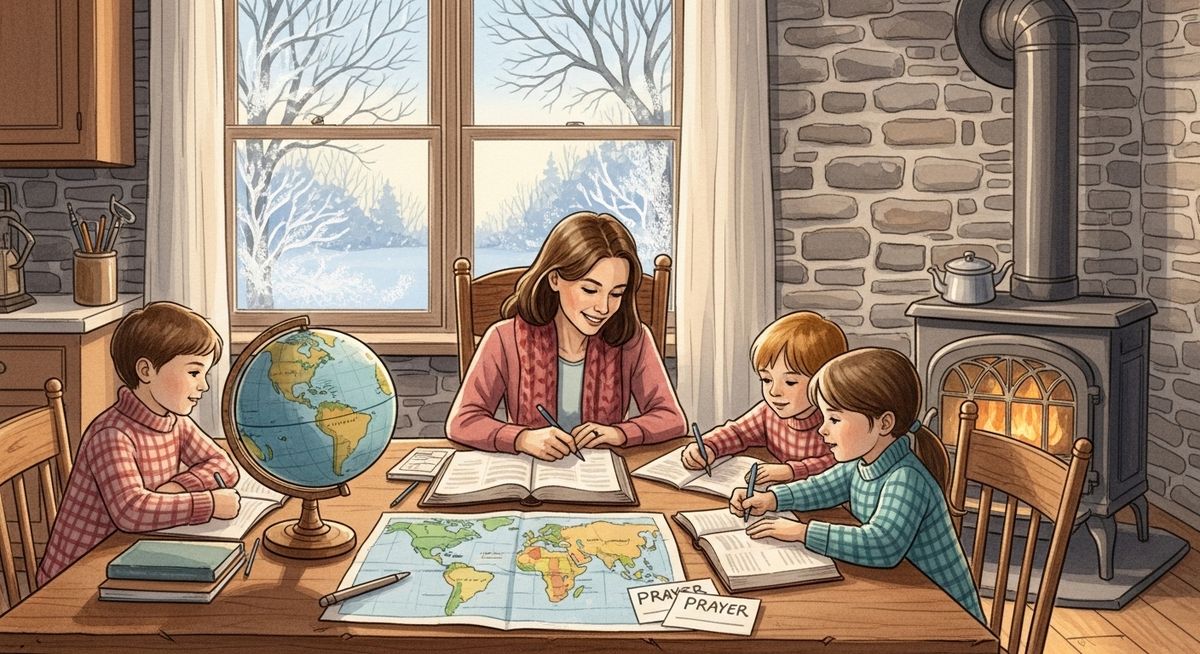
The frost had crept across the windowpanes overnight, tracing fern-leaf patterns on the old glass. Outside, the fields of Lancaster County lay still and silver under a pale morning sky, and a thin column of smoke rose from the chimney of the stone farmhouse at the end of the lane. Inside, the wood-burning stove in the kitchen ticked and settled as the fire took hold. Rachel set a pot of oatmeal on the stovetop, then cleared the breakfast dishes to make room for the day’s lessons. The kitchen table was a wide plank of reclaimed oak, scarred by generations of use, and it served as desk, laboratory, art studio, and dining table in rotating shifts throughout the day. This morning it would also become a window to the other side of the world.
Her four children settled into their places. Twelve-year-old Micah, ten-year-old Hannah, seven-year-old Ezra, and four-year-old Naomi. Rachel placed a laminated people group card on the table between the spelling workbook and the basket of colored pencils. The card showed a photograph of a Baloch family in southeastern Iran: a woman in a richly embroidered dress, two children standing close, a man with a weathered face squinting against the desert sun. Behind them, a flat-roofed mud-brick home and a landscape of dry hills that looked nothing like the green rolling farmland outside the window.
“The Baloch people,” Rachel said. “Twenty million of them, spread across Iran, Pakistan, and Afghanistan. Almost none of them have ever heard the name of Jesus.” Micah found Iran on the globe and traced the border with his finger. Hannah opened her journal and wrote the name carefully at the top of a fresh page. Ezra studied the photograph and asked what the embroidery meant. Naomi pressed her face close to the card and whispered, “They look nice.”
Rachel opened her Bible to Revelation 7:9 and read aloud: “After this I looked, and behold, a great multitude that no one could number, from every nation, from all tribes and peoples and languages, standing before the throne and before the Lamb.” She paused. “The Baloch people are one of those nations. They are part of God’s plan. And today we get to learn their name and pray for them.”
They prayed. Four voices around a kitchen table in Pennsylvania, lifting up a people they had never met in a land they had never seen, trusting that the God who commands the nations to worship Him is also the God who hears the prayers of children. The whole thing took fifteen minutes. Then they moved on to fractions.
This is what missions education looks like in a Pennsylvania homeschool. Not a separate textbook or a Friday afternoon elective, but a thread woven through the ordinary rhythm of a school day. A globe on the table. A name spoken aloud. A prayer offered before the math lesson begins. And over weeks and months and years, a child’s understanding of God’s purposes stretched wide enough to hold the whole world.
Pennsylvania Homeschool Requirements: What You Need to Know
Pennsylvania has some of the most detailed homeschool regulations in the country. If you are homeschooling in the Keystone State, you are already familiar with paperwork. But the good news is that the same structure that requires careful planning also provides natural entry points for missions education across multiple subjects.
Here is what Pennsylvania law requires. Before the start of each school year, you must file a notarized affidavit with your local school district superintendent, typically by August 1. The affidavit confirms that you will provide instruction in the required subjects and includes written educational objectives for each child. You must maintain a portfolio of your child’s work throughout the year, including samples, log entries, and any standardized test results. At the end of the year, a certified evaluator (a licensed teacher, psychologist, or other approved professional) reviews the portfolio and writes a letter affirming that your child received an “appropriate education.” Standardized testing is required in grades 3, 5, and 8. Students must be tested using a nationally normed test, and scores must be included in the portfolio.
The required subjects are extensive: English (including spelling, reading, and writing), mathematics, social studies (including geography, civics, and the history of the United States, the Commonwealth of Pennsylvania, and the world), science, health and physiology, physical education, music, and art. For secondary students, additional requirements include American and Pennsylvania literature, and the history of Pennsylvania’s role in the nation’s development.
That list might look like a constraint, but for missions-minded families, it is an open door. Missions education integrates naturally into at least five of those required areas. Social studies? Geography, world cultures, and global civics are the backbone of any serious study of unreached people groups. English? Missionary biographies, journal writing about the nations, and letters to missionary families cover reading, writing, and composition. Science? Study the ecosystems, climates, and agriculture of the regions where unreached peoples live. Art? Explore the textile patterns, pottery traditions, and visual arts of cultures around the world. Music? Learn the instruments, rhythms, and worship songs of the global church. When you document these activities in your portfolio, you are not padding the record. You are showing that your child engaged with the world in precisely the ways Pennsylvania’s educational objectives intend. For a comprehensive framework that maps missions to standard academic subjects, our homeschool missions curriculum guide walks through the full integration process.
Why Missions Belongs in Your Pennsylvania Homeschool
There is a temptation, especially in a state with rigorous documentation requirements, to treat education as a compliance exercise. Check the boxes. Log the hours. Produce the portfolio. Move on. And if that is all education is, then missions might seem like a luxury, a nice supplement for families with extra time and a heart for global causes. But if education is formation, if the purpose of teaching your children is to shape their understanding of God, themselves, and the world they inhabit, then missions is not optional. It is essential.
The Bible does not present God’s concern for the nations as a secondary theme. It is the storyline. From God’s promise to Abraham in Genesis 12, “in you all the families of the earth shall be blessed,” to Christ’s commission in Matthew 28, “go therefore and make disciples of all nations,” to the final vision of redeemed humanity in Revelation 7, gathered from every tribe and tongue and people and language, the entire arc of Scripture moves toward one destination: the worship of God among all peoples. Every book of the Bible sits within that trajectory. Every doctrine of the faith intersects with it. Election, atonement, regeneration, sanctification: none of these can be fully understood apart from God’s global purposes. When John Piper wrote that “missions exists because worship doesn’t,” he was not offering a clever phrase for a conference banner. He was stating the central problem of human history. There are peoples on this planet who have never worshiped the living God. Missions exists to change that.
“May the peoples praise you, O God; may all the peoples praise you. May the nations be glad and sing for joy, for you rule the peoples with equity and guide the nations of the earth.” (Psalm 67:3-4)
Mark Dever has emphasized that the local church is the primary sending and supporting structure for missions. Families are not a replacement for the church in this work. But families are where the first seeds take root. When you teach your seven-year-old to pray for the Baloch people of Iran, you are doing something that a single Sunday school lesson cannot replicate. You are building a daily habit of attention to God’s global purposes. You are making the Great Commission as familiar as the catechism. You are teaching your children that the God they worship is not merely the God of their church, their town, or their country. He is the God of the Sindhi weaver in Pakistan, the Berber shepherd in Morocco, the Tibetan nomad on the high plateau, and the Baloch family in the photograph on your kitchen table. His glory is the reason for missions. His sovereignty is the ground of our confidence. And your farmhouse in Pennsylvania is one of the places where that confidence is planted in the hearts of the next generation.
The Reformed tradition, which runs deep in Pennsylvania’s own history, has always understood that God’s purposes in salvation are global in scope. The Westminster Shorter Catechism, drafted in London but cherished by the Presbyterian churches that shaped so much of Pennsylvania’s spiritual landscape, begins with the question, “What is man’s chief end?” and answers, “Man’s chief end is to glorify God, and to enjoy him forever.” But God is not content to be glorified by English-speaking families in Chester County alone. He intends to be glorified by the Shaikh of Bangladesh, the Jat of Pakistan, the Brahmin of India, and the Arab of Iraq. Teaching your children about these peoples is not a peripheral activity. It is an act of worship. It is a declaration, made with your whole curriculum, that the nations belong to Him.
A Week of Missions in Your Pennsylvania Home
The most common question from Pennsylvania homeschool parents is a practical one: “How do I fit this into our week when we already have so many required subjects to document?” The answer is that missions does not require a separate time block. It weaves into what you are already teaching. Fifteen minutes a day, five days a week, integrated into the subjects you are already logging for your portfolio. Here is a sample weekly rhythm.
| Day | Time | Activity | PA Subject Credit | Resource |
|---|---|---|---|---|
| Monday | 15 min | People group introduction: name, location, population, religion, one cultural detail. Find them on the globe. Say their name aloud. | Social Studies (geography, world cultures) | Printable Missions Lesson Plans |
| Tuesday | 15 min | Geography and culture study: map the country, learn three facts about daily life, try a greeting in their language. | Social Studies, English (reading) | World map or atlas, Missions Through Geography |
| Wednesday | 20 min | Missionary biography reading: read a chapter from a missionary who served in the same region. Discuss and narrate. | English (reading, comprehension), History | Missions Books for Kids |
| Thursday | 20 min | Hands-on activity: color a cultural scene, cook a simple recipe, or complete a craft project from the people group’s region. | Art, Health/Home Economics | Christian Coloring Pages, Missions Craft Projects |
| Friday | 15 min | Family prayer and journaling: review the week’s people group, write a prayer in your missions journal, add a pin to your prayer map. | English (writing, composition) | Missions Prayer Cards |
That is roughly an hour and twenty-five minutes across the entire week. Less than the time most families spend on a single subject in a single day. And because each activity maps directly to a required Pennsylvania subject, every minute counts toward your portfolio documentation. When your evaluator reviews your child’s missions journal, world map with labeled people groups, and written prayers, they will see evidence of geography, composition, world cultures, and art, all in one integrated unit.
By the end of a school year, your children will have studied over thirty people groups, read missionary biographies spanning centuries and continents, prayed by name for communities they may never visit, and developed a sense of the world that most adults never acquire. That is an education worth documenting.
You can adapt this rhythm to fit your family’s schedule. If mornings are reserved for math and language arts, shift the missions block to after lunch. If Wednesdays are co-op days, double up on Thursday. The structure is flexible. The consistency is what matters.
For families who want a deeper dive, our printable missions lesson plans include 30-minute and 1-hour frameworks with discussion questions, Scripture connections, and response activities for multiple age groups.
Pennsylvania-Specific Connections: The Nations Are Already Here
One of the most remarkable things about teaching missions in Pennsylvania is that the state itself is a living textbook. God, in His providence, has brought the nations to the Keystone State. And the history of Pennsylvania is deeply woven into the story of Protestant missions in ways that most families have never discovered.
Philadelphia: A Global City at Your Doorstep
Philadelphia is one of the most ethnically and linguistically diverse cities in the United States. More than 100 languages are spoken across the metro area. The city is home to significant Vietnamese, Chinese, Ethiopian, Liberian, Puerto Rican, and Mexican communities. South Philadelphia’s Italian Market sits alongside Vietnamese grocery stores and Mexican taquerias. Upper Darby has become one of the largest Liberian communities outside of West Africa. Northeast Philadelphia is home to thriving communities of Chinese, Korean, and Russian-speaking families. When your child studies the peoples of Southeast Asia on Monday morning, you can drive to the heart of Philadelphia and walk through neighborhoods where those languages are spoken in the shops and on the streets. The people your children pray for are not abstractions. They may live forty-five minutes down the turnpike.
Pittsburgh: A Growing Refugee Community
Pittsburgh has quietly become one of the most significant refugee resettlement cities in Pennsylvania. The Bhutanese and Nepali refugee community in Pittsburgh’s South Side and surrounding neighborhoods is one of the largest in the country. Thousands of families, many of them Hindu or Buddhist, have been resettled from refugee camps in Nepal where they lived for decades after being expelled from Bhutan. The city also hosts growing Iraqi, Syrian, Somali, and Congolese communities. For homeschool families in western Pennsylvania, these are not distant people groups on a laminated card. They are neighbors. A field trip to a community center serving refugee families, or a visit to a Nepali grocery store, can bring your Monday morning lesson to life in ways a textbook never could.
Lancaster County: Anabaptist Missions Heritage
Lancaster County is best known for its Amish and Old Order Mennonite communities, and most visitors see only the buggies and the quilt shops. But the Mennonite tradition carries one of the deepest missions legacies in Protestant history. Mennonites were among the earliest Protestant missionaries, sending workers to the Caribbean, Africa, India, and Southeast Asia centuries before the modern missions movement is typically dated. The Mennonite Central Committee, headquartered in nearby Akron, Pennsylvania, has been operating relief and development programs among unreached and under-reached communities around the world since 1920. A visit to the MCC material resources center, where your children can see quilts, school kits, and relief supplies being packed for shipment overseas, is a powerful, tangible lesson in what it means for the church to serve the nations. Lancaster County is not just a picturesque backdrop for your homeschool. It is a living connection to centuries of cross-cultural gospel work.
Bethlehem and Nazareth: The Moravian Missions Story
Two Pennsylvania towns bear names that point directly to the land of the Bible, and both were founded by Moravian settlers whose passion for missions shaped the course of Protestant evangelism worldwide. The Moravian Church, established in Bethlehem in 1741, became one of the most extraordinary missionary movements in Christian history. Within twenty years of their founding, Moravian missionaries had gone to the Caribbean, Greenland, southern Africa, and to Native American communities across Pennsylvania and the Ohio Valley. The Moravians are credited with launching the first sustained Protestant mission to enslaved peoples in the West Indies. Their community in Bethlehem operated a 24-hour prayer chain for missions that continued without interruption for over a hundred years.
Today you can visit the Moravian Museum of Bethlehem and the God’s Acre cemetery, where missionaries are buried alongside the community members who prayed for them and supported them. You can walk through the historic district of Nazareth and see the buildings where missionaries were trained and sent. For Pennsylvania homeschool families, a day trip to Bethlehem or Nazareth is not just a history lesson. It is a chance to stand on ground where the Great Commission was taken with absolute seriousness, and to tell your children, “This is our heritage. This is what it looks like when ordinary Christians decide that the nations matter.”
Harrisburg and Central Pennsylvania: Refugee Resettlement
Harrisburg and the surrounding region serve as another major hub for refugee resettlement in Pennsylvania. Families from Bhutan, Myanmar, Somalia, Iraq, and the Democratic Republic of Congo have been resettled throughout the greater Harrisburg area. Church World Service and other agencies have placed families in communities across central Pennsylvania, creating opportunities for local churches and homeschool families to serve, welcome, and build relationships across cultural lines. When your children pray for the peoples of the Middle East or East Africa, those prayers find a tangible connection in families who may attend the same grocery store or public library.
Practical Ways to Connect
Here are some ways to link your missions curriculum to Pennsylvania’s own story:
- Visit the Moravian Museum in Bethlehem and study the history of Moravian missions as part of your Pennsylvania history unit. Connect it to the broader story of the Great Commission across the centuries.
- Explore Philadelphia’s diverse neighborhoods. Eat at an Ethiopian restaurant. Visit the Vietnamese shops along Washington Avenue. Let your children hear languages they have been studying.
- Partner with a refugee resettlement organization in Pittsburgh, Harrisburg, or Philadelphia. Help a family practice English. Bring a meal. Let your children see that “the nations” are real people with real names.
- Study the Mennonite missions heritage at the MCC center in Akron. Volunteer to pack school kits or relief supplies as a hands-on service project.
- Attend a worship service at an immigrant church. Many Korean, Vietnamese, Liberian, and Ethiopian congregations across Pennsylvania welcome visitors with warmth.
- Pray specifically for the unreached communities in your own metro area. Use the Joshua Project database to find people group profiles for populations near you.
Bringing It Home: Wonder Letters as a Monthly Companion
If the idea of building a weekly missions rhythm sounds compelling but the preparation feels overwhelming, you are not alone. Pennsylvania homeschool parents are already managing one of the most documentation-intensive systems in the country. Between portfolio preparation, evaluator meetings, standardized testing, and the daily demands of teaching multiple children, adding one more thing to research and plan can feel like too much.
That is exactly why Wonder Letters exists. Each month, a hand-illustrated letter arrives in your mailbox, written from the perspective of a child living among an unreached people group. The letter introduces a real people group, a real culture, and real prayer needs, all through the eyes of a child your kids can relate to. Each letter includes a QR code linking to bonus content, activities, and prayer guides. It is designed to be picked up, read aloud at the kitchen table, and discussed as a family, with zero preparation required on your part.
A monthly subscription costs ten dollars. An annual subscription is one hundred and two dollars, which works out to eight-fifty a month. And fifty percent of every dollar goes directly to support work among unreached people groups through Global Serve International. When your family subscribes, you are not just learning about missions. You are participating in missions.
For Pennsylvania families, Wonder Letters pairs naturally with the weekly rhythm described above. Use the monthly letter as your Monday introduction to a new people group, then spend the rest of the week going deeper with geography, biography, art, and prayer. The letter does the heavy lifting of cultural context and storytelling. You provide the globe, the Bible, and the willingness to pray. And when your evaluator opens your portfolio in the spring, the missions journal, the labeled maps, the written prayers, and the hand-colored illustrations will tell a story of an education that was both rigorous and Christ-centered.
You can start a monthly subscription or save with an annual plan and have your first letter on its way within the week.
Free Resources to Get Started This Week
You do not need to wait for a curriculum to arrive in the mail to begin. There are enough free resources available right now to start your missions rhythm this Monday.
Our homeschool missions curriculum guide is the most comprehensive starting point. It walks through the theological foundations, the practical frameworks, and the age-specific adaptations for teaching missions at home. If you read one thing before Monday morning, read that.
For ready-made lesson structures, the printable missions lesson plans give you 15-minute, 30-minute, and 1-hour templates that work with any people group profile. Print one, grab a globe, and you are ready. If your children are younger and need a visual entry point, our Christian coloring pages include scenes from cultures around the world that pair well with a people group study.
If your family enjoys reading together, missions books for kids provides a curated list of missionary biographies and missions-themed stories organized by age group. For older children, the article What Is a Missionary? offers a thoughtful, Scripture-grounded exploration of calling and sending that can spark rich dinner-table conversation.
Prayer is the backbone of any missions curriculum, and missions prayer cards for kids gives you a tangible way to build a family prayer practice around specific people groups. Print a set, keep them in a basket on the table, and pull one out each morning before school begins.
For churches and co-ops looking for a group format, our VBS missions curriculum adapts the same content into a five-day program that works beautifully for summer Vacation Bible School or a missions-themed co-op week. And if you want to understand the biblical and theological foundations more deeply, What Are Unreached People Groups? and Praying for Unreached People Groups will ground your family’s study in the urgency and the hope of the Great Commission.
For Pennsylvania families looking for additional documentation ideas, consider having your children write brief reports on each people group they study. A one-paragraph summary by a seven-year-old and a two-page essay by a twelve-year-old, both filed in the portfolio, demonstrate writing, geography, and cultural studies in a format any evaluator will appreciate.
The Faithful, Ordinary Work
There will be mornings when the oatmeal boils over and the four-year-old hides the globe under the couch. There will be weeks when Wednesday’s missionary biography gets replaced by a trip to the pediatrician and an unexpected repair to the wood stove. There will be entire months when the portfolio feels like it is growing faster than your children, and the evaluator meeting in the spring looms larger than the Great Commission. That is fine. Grace covers the gaps. Consistency over perfection. Fifteen minutes a week is better than an hour that never happens, and an imperfect start is infinitely better than a perfect plan that stays on the shelf.
The Spirit of God does not need a flawless lesson plan to move in your child’s heart. He needs a willing parent, an open Bible, and a name spoken aloud. He can take a four-year-old’s whispered prayer for a Baloch family “to know Jesus loves them” and do immeasurably more with it than we can ask or imagine. Your job is not to produce little missionaries. Your job is to set the table, literally and figuratively, and to trust that the God who commands the nations to worship Him is also the God who sovereignly draws them to Himself.
Pennsylvania has a heritage of taking the Great Commission seriously. The Moravians in Bethlehem prayed without ceasing for the nations. The Mennonites in Lancaster sent their sons and daughters to the ends of the earth. The churches of Philadelphia have welcomed refugees from every continent. That heritage is not a museum exhibit. It is a living inheritance, and your family is part of it. Your stone farmhouse, your kitchen table, your children gathered around a laminated card and a well-worn globe: this is the next chapter in a story that stretches back to Abraham and forward to the throne of the Lamb.
Start there. Start this Monday. Fifteen minutes is enough. The God who called the nations into being will meet you at the table.
Explore Guides for Other States
Every state has homeschool families teaching their children about God’s heart for the nations. Browse our other state-specific guides, or return to the Homeschool Missions Curriculum hub for a complete framework.
- Homeschool Missions Curriculum for California
- Homeschool Missions Curriculum for Florida
- Homeschool Missions Curriculum for Georgia
- Homeschool Missions Curriculum for Illinois
- Homeschool Missions Curriculum for New York
- Homeschool Missions Curriculum for North Carolina
- Homeschool Missions Curriculum for Ohio
- Homeschool Missions Curriculum for Texas
- Homeschool Missions Curriculum for Virginia
Brought to you by Wonder Letters
Monthly missions letters for families. 50% of profits support Global Serve International.