Homeschool Missions Curriculum for Texas: A Family Guide
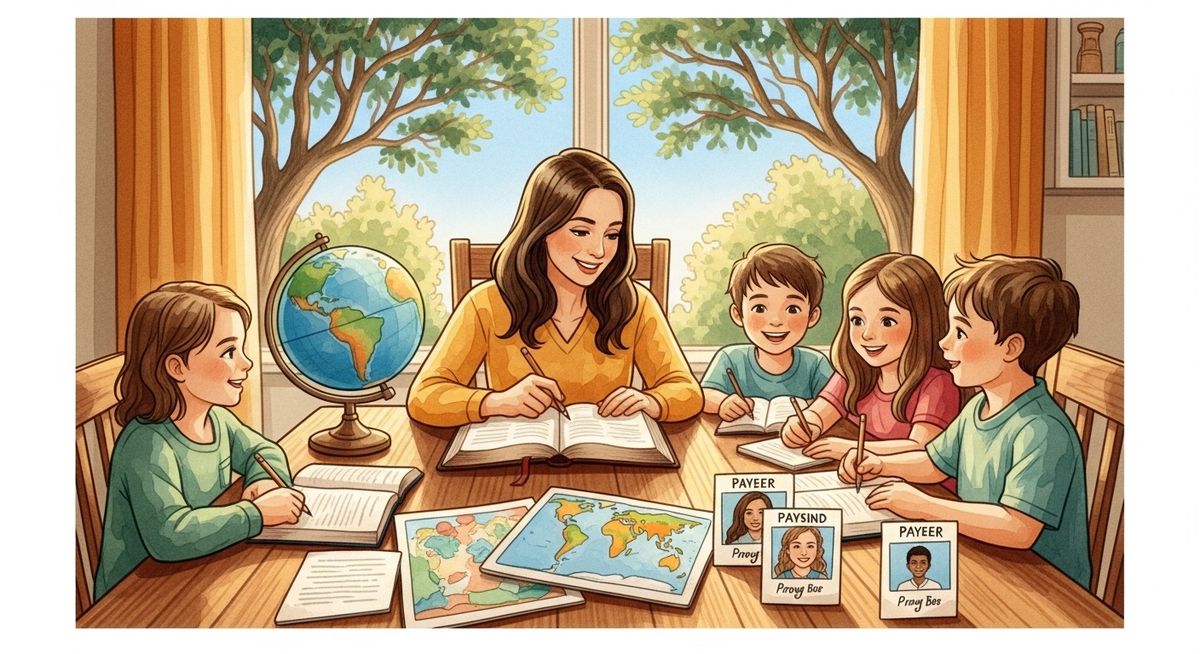
The ceiling fan turned slow circles above the kitchen table. Outside, the morning sun was already warming the red dirt of their East Texas property, and the cicadas had started their electric hum in the live oaks along the fence line. Inside, the air conditioning kept things cool enough for concentration. Sarah set a laminated people group card on the table between the math workbook and the jar of sharpened pencils. Her three children, ten-year-old Caleb, seven-year-old Lily, and four-year-old Samuel, leaned in to look at the card. A photograph of a Fulani woman in a bright indigo wrap, balancing a calabash on her head, walking along a dusty path somewhere in northern Nigeria.
“Where do the Fulani people live?” Sarah asked. Caleb spun the globe and stopped it with his finger on West Africa. Lily traced the curve of the Niger River. Samuel put his whole palm on the continent because he liked the feel of the raised mountain ridges under his fingers. Sarah read aloud from the card: eighteen million Fulani people, spread across a dozen countries, most of them Muslim, many of them nomadic cattle herders who follow the rains across the Sahel. She described the smell of woodsmoke and fresh milk in a Fulani camp at dawn, the sound of cattle bells, the low murmur of morning prayers. Then she opened her Bible to Psalm 67 and read, “May God be gracious to us and bless us and make his face to shine upon us, that your way may be known on earth, your saving power among all nations.”
Lily looked at the photograph again. “Does she know about Jesus?” she asked.
“Most Fulani people have never heard the gospel,” Sarah said. “That is why we pray.”
They prayed. Each child, one sentence. Samuel prayed that the Fulani lady would “find Jesus in the morning.” Sarah wrote the date and the people group name in their prayer journal. The whole thing took twelve minutes. Then they moved on to long division.
This is what missions education looks like in a Texas homeschool. Not a separate subject crammed into an already full schedule, but a thread woven through the fabric of an ordinary Tuesday. A globe on the kitchen table. A name spoken aloud. A prayer offered before the math lesson begins. And over time, week by week, a child’s heart stretched wide enough to hold the nations.
Texas Homeschool Requirements: A Brief Overview
Texas is one of the most homeschool-friendly states in the country. The legal framework is simple: a homeschool in Texas operates as a private school. There is no requirement to notify the state, no mandatory standardized testing, no portfolio reviews, and no obligation to use state-approved curriculum. The Texas Education Code, as interpreted by the landmark 1994 Texas Supreme Court ruling in Leeper v. Arlington ISD, requires that a homeschool pursue a course of study in good faith that covers five subjects: reading, spelling, grammar, mathematics, and good citizenship.
That is the entire legal framework. Five subjects, pursued in good faith, using a written curriculum of the family’s choosing. No annual assessments. No reporting. No bureaucratic oversight. For Christian families who want to teach their children about God’s heart for the nations, this freedom is a gift.
Missions education fits naturally within those five required areas. Reading? Missionary biographies and people group profiles. Spelling and grammar? Written prayers, journal entries about unreached nations, letters to missionary families. Mathematics? Population statistics, currency conversions, distance calculations on a world map. Good citizenship? There is no better training in global citizenship than learning the names, cultures, and needs of people on the other side of the world and praying for them by name. If you are looking for a comprehensive framework, our homeschool missions curriculum guide walks through the full integration process.
Why Missions Belongs in Your Texas Homeschool
There is a theological reason why missions is not an elective. It is not a nice addition to your curriculum if you happen to have extra time on Friday afternoons. Missions is the heartbeat of Scripture, the storyline that runs from God’s promise to Abraham in Genesis 12 (“in you all the families of the earth shall be blessed”) to the vision of the redeemed in Revelation 7:9 (“a great multitude that no one could number, from every nation, from all tribes and peoples and languages, standing before the throne”). The whole Bible moves toward this moment. Every tribe. Every tongue. Every people. Gathered before the Lamb.
John Piper wrote that “missions exists because worship doesn’t.” That sentence has shaped a generation of Christians, and it should shape the way we educate our children. The reason we send missionaries is not primarily because people are in need, though they are. The reason we send missionaries is because God is worthy of worship from every people group on the planet, and right now, thousands of those groups have never heard His name. The Great Commission in Matthew 28 is not a suggestion for the especially zealous. It is marching orders for the whole church. And the training ground for the church is the family.
“May the peoples praise you, O God; may all the peoples praise you. May the nations be glad and sing for joy, for you rule the peoples with equity and guide the nations of the earth.” (Psalm 67:3-4)
Mark Dever has written extensively about the local church as the sending agency for missions. Families do not replace the church in this work. But families are where the first seeds are planted. When you teach your six-year-old to pray for the Berber people of North Africa, you are doing something that the Sunday school hour alone cannot accomplish. You are building a daily rhythm of attention to the nations. You are making the Great Commission as familiar as the multiplication table. You are teaching your children that the God they worship on Sunday morning is the God of the Uzbek farmer, the Somali fisherman, the Tibetan nomad, and the Fulani cattle herder. His glory is the reason for missions. His sovereignty is the ground of our confidence. And your kitchen table in Texas is one of the places where that confidence takes root.
The Reformed tradition has always understood that God’s purposes in salvation are global. The Westminster Shorter Catechism begins with the question, “What is man’s chief end?” and answers, “Man’s chief end is to glorify God, and to enjoy him forever.” But God is not content to be glorified by English-speaking families in the Texas Hill Country alone. He intends to be glorified by the Shaikh of Bangladesh, the Jat of Pakistan, the Brahmin of India, and the Arab of Iraq. Teaching your children about these peoples is not a peripheral activity. It is an act of worship. It is a declaration that God’s glory matters more than test scores, more than college transcripts, more than the next standardized benchmark. It is a way of saying, with your whole curriculum, that the nations belong to Him.
A Week of Missions in Your Texas Home
One of the most common questions from homeschool parents is, “How do I actually fit this into our week?” The answer is simpler than you think. You do not need a separate missions class. You need fifteen minutes a day, five days a week, woven into what you are already doing. Here is a sample weekly rhythm.
| Day | Time | Activity | Resource |
|---|---|---|---|
| Monday | 15 min | People group introduction: name, location, population, religion, one cultural detail. Find them on the globe. Say their name aloud. | Printable Missions Lesson Plans |
| Tuesday | 15 min | Geography and culture study: map the country, learn three facts about daily life, try a greeting in their language. | World map or atlas, Missions Through Geography |
| Wednesday | 20 min | Missionary biography reading: read a chapter from a missionary who served in the same region. | Missions Books for Kids |
| Thursday | 20 min | Hands-on activity: color a scene from the people group’s culture, cook a simple recipe, or work on a craft project. | Christian Coloring Pages, Missions Craft Projects |
| Friday | 15 min | Family prayer and journaling: review the week’s people group, write a prayer in your missions journal, add a pin to your prayer map. | Missions Prayer Cards |
That is roughly an hour and twenty-five minutes across the entire week. Less than the time most families spend on a single subject in a single day. And the cumulative effect over a school year is extraordinary. By May, your children will have studied thirty-six people groups, read missionary biographies spanning three centuries, prayed by name for communities they may never visit, and developed a sense of the world that most adults never acquire.
You can adapt this rhythm to your family’s schedule. If your mornings are packed with core subjects, move the missions block to after lunch. If Wednesdays are co-op days, double up on Thursday. The structure is flexible. The consistency is what matters. A child who prays for the nations every week for ten years will not easily forget that the world is bigger than their county.
For families who want a deeper dive, our printable missions lesson plans include 30-minute and 1-hour frameworks with discussion questions, Scripture connections, and response activities for multiple age groups.
Texas-Specific Connections: The Nations Are Already Here
One of the most remarkable things about teaching missions in Texas is that you do not have to look far to find the nations. God, in His providence, has brought the world to your state. Texas is home to some of the most culturally diverse cities in the United States, and the unreached people groups your children study on Monday morning may be living thirty minutes down the highway.
Houston is one of the most ethnically diverse cities in America. More than 145 languages are spoken in the Houston metropolitan area. The city is home to large Vietnamese, Nigerian, Indian, Chinese, and Pakistani communities. The Mahatma Gandhi District along Hillcroft Avenue is a crossroads of South Asian, Middle Eastern, and African cultures, with grocery stores selling spices your children can smell from the parking lot, restaurants serving dishes from a dozen nations, and mosques and temples standing alongside churches. When your child studies the Shaikh people of Bangladesh, you can drive to southwest Houston and walk through a neighborhood where Bengali is spoken in the shops.
Dallas-Fort Worth has become a major resettlement hub for refugees from Iraq, Somalia, Myanmar, and the Democratic Republic of Congo. The Vickery Meadow neighborhood in Dallas is sometimes called “the most diverse square mile in Texas,” home to families from over thirty countries. Irving and Arlington have significant Iraqi and Afghan populations. When your children pray for the Iraqi Arab people, those prayers have a geographic specificity that textbooks cannot provide. The people they are praying for may live in the next zip code.
San Antonio carries a unique missions heritage. The city’s five Spanish colonial missions, including the Alamo (originally Mission San Antonio de Valero), were established in the 18th century as outposts of the Catholic church’s evangelization efforts among indigenous peoples. Whatever one thinks of the methods and theology of the Spanish missions, the historical fact remains: San Antonio was built on the idea that the gospel should cross cultural boundaries. Walking the grounds of Mission San Jose with your children and telling the story of how the gospel has always been a message meant to travel is a field trip that no other state can replicate in quite the same way.
The Texas-Mexico border region offers yet another layer. Families in the Rio Grande Valley live within driving distance of communities where cross-cultural ministry happens daily. El Paso and Ciudad Juarez are separated by a river but connected by centuries of shared culture, shared families, and shared need for the gospel. For Texas homeschool families, the border is not an abstraction on a map. It is a place where your children can see, firsthand, what it means to love your neighbor across a cultural and national boundary.
Here are some practical ways to connect your missions curriculum to your Texas context:
- Visit a cultural district in Houston, Dallas, or San Antonio. Eat at an Ethiopian restaurant. Buy spices at a Middle Eastern grocery. Let your children hear languages they have been studying.
- Attend a worship service at an immigrant church. Many Iraqi, Korean, Vietnamese, and Nigerian congregations in Texas welcome visitors warmly.
- Partner with a local refugee resettlement organization. Help a family practice English. Bring a meal. Let your children see that “the nations” are not abstract categories but real people with real names.
- Study the history of the Spanish missions in San Antonio as part of your Texas history unit. Connect it to the broader story of global missions across the centuries.
- Pray specifically for the unreached communities in your own metro area. Use the Joshua Project database to find people group profiles for populations near you.
Bringing It Home: Wonder Letters as a Monthly Companion
If the idea of building a weekly missions rhythm sounds compelling but the preparation feels overwhelming, you are not alone. Most homeschool parents are already juggling five or six subjects, co-op schedules, meal planning, and the thousand small demands of daily life. Adding one more thing to prepare can feel like too much.
That is exactly why Wonder Letters exists. Each month, a hand-illustrated letter arrives in your mailbox, written from the perspective of a child living among an unreached people group. The letter introduces a real people group, a real culture, and real prayer needs, all through the eyes of a child your kids can relate to. Each letter includes a QR code linking to bonus content, activities, and prayer guides. It is designed to be picked up, read aloud at the kitchen table, and discussed as a family, with zero preparation required on your part.
A monthly subscription costs ten dollars. An annual subscription is one hundred and two dollars, which works out to eight-fifty a month. And fifty percent of every dollar goes directly to support work among unreached people groups through Global Serve International. So when your family subscribes, you are not just learning about missions. You are participating in missions.
For Texas families, Wonder Letters pairs naturally with the weekly rhythm described above. Use the monthly letter as your Monday introduction to a new people group, then spend the rest of the week going deeper with geography, biography, and prayer. The letter does the heavy lifting of cultural context and storytelling. You provide the globe, the Bible, and the willingness to pray.
You can start a monthly subscription or save with an annual plan and have your first letter on its way within the week.
Free Resources to Get Started This Week
You do not need to wait for a curriculum to arrive in the mail to begin. There are enough free resources available right now to start your missions rhythm this Monday.
Our homeschool missions curriculum guide is the most comprehensive starting point. It walks through the theological foundations, the practical frameworks, and the age-specific adaptations for teaching missions at home. If you read one thing before Monday morning, read that.
For ready-made lesson structures, the printable missions lesson plans give you 15-minute, 30-minute, and 1-hour templates that work with any people group profile. Print one, grab a globe, and you are ready. If your children are younger and need a visual entry point, our Christian coloring pages include scenes from cultures around the world that pair well with a people group study.
If your family enjoys reading together, missions books for kids provides a curated list of missionary biographies and missions-themed stories organized by age group. For older children, the article What Is a Missionary? offers a thoughtful, Scripture-grounded exploration of calling and sending that can spark rich dinner-table conversation.
Prayer is the backbone of any missions curriculum, and missions prayer cards for kids gives you a tangible way to build a family prayer practice around specific people groups. Print a set, keep them in a basket on the table, and pull one out each morning before school begins.
For churches and co-ops looking for a group format, our VBS missions curriculum adapts the same content into a five-day program that works beautifully for summer Vacation Bible School or a missions-themed co-op week. And if you want to understand the biblical and theological foundations more deeply, What Are Unreached People Groups? and Praying for Unreached People Groups will ground your family’s study in the urgency and the hope of the Great Commission.
The Faithful, Ordinary Work
There will be mornings when your four-year-old spins the globe off the table. There will be weeks when Wednesday’s missionary biography gets swallowed by a dentist appointment and a grocery run. There will be seasons when the whole family is tired and the missions block feels like one obligation too many. That is fine. Grace covers the gaps. Fifteen minutes a week is better than nothing, and nothing is better than the guilt of a perfectly designed curriculum that sits unused on the shelf.
The Spirit of God does not need a flawless lesson plan to move in your child’s heart. He needs a willing parent, an open Bible, and a name spoken aloud. He can take a four-year-old’s prayer for a Fulani woman “to find Jesus in the morning” and do immeasurably more with it than we can ask or imagine. Your job is not to produce little missionaries. Your job is to set the table, literally and figuratively, and to trust that the God who commands the nations to worship Him is also the God who sovereignly draws them to Himself. Your kitchen table in Texas is part of that story.
Missions exists because worship doesn’t. And worship begins, for many children, in the most ordinary place imaginable: a cleared breakfast table, a laminated card, a globe with a wobbly axis, and a parent who believes that the nations matter to God. Start there. Start this Monday. Fifteen minutes is enough.
Explore Guides for Other States
Every state has homeschool families teaching their children about God’s heart for the nations. Browse our other state-specific guides, or return to the Homeschool Missions Curriculum hub for a complete framework.
- Homeschool Missions Curriculum for California
- Homeschool Missions Curriculum for Florida
- Homeschool Missions Curriculum for Georgia
- Homeschool Missions Curriculum for Illinois
- Homeschool Missions Curriculum for New York
- Homeschool Missions Curriculum for North Carolina
- Homeschool Missions Curriculum for Ohio
- Homeschool Missions Curriculum for Pennsylvania
- Homeschool Missions Curriculum for Virginia
Brought to you by Wonder Letters
Monthly missions letters for families. 50% of profits support Global Serve International.