Homeschool Missions Curriculum for Virginia: A Family Guide
The kitchen windows were fogged with the steam of a second pot of coffee. Outside, the dogwood branches were still bare, but the earliest buds had begun to swell along the tips, promising the white blossoms that would line every road in the county within a few weeks. Beyond the back fence, the foothills of the Blue Ridge rose in soft gray ridges against the morning sky. The Shenandoah Valley in early March has a quiet, expectant quality, like the world is holding its breath before spring arrives.
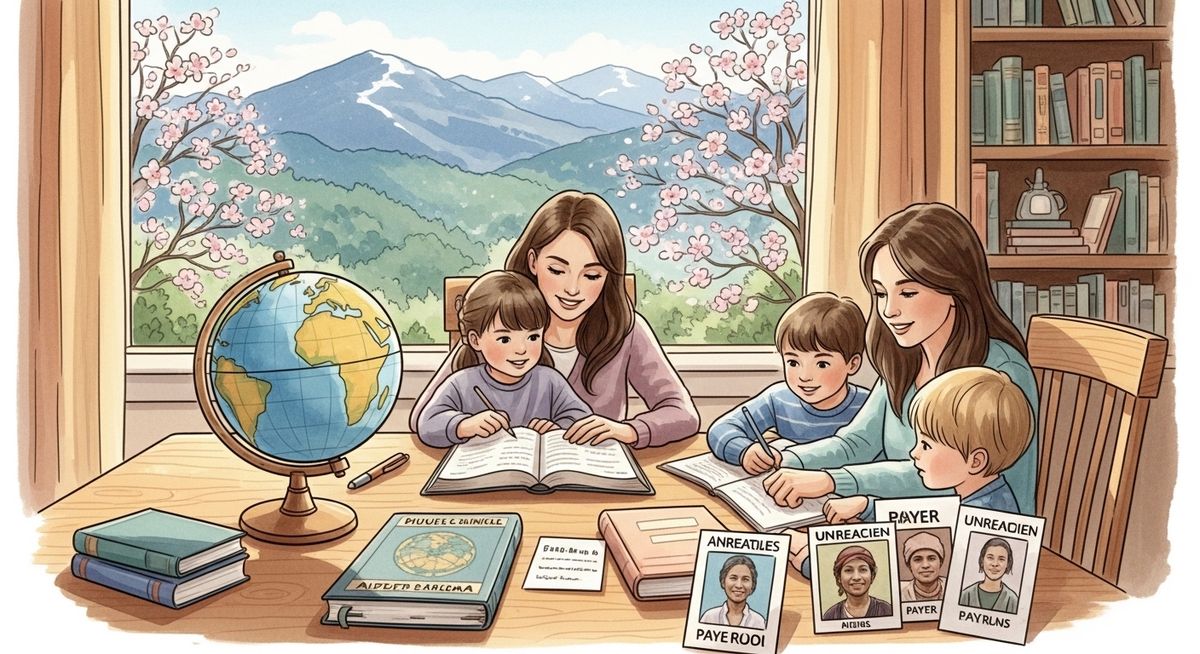
Inside, the kitchen table was covered with the familiar chaos of a homeschool morning: a math workbook open to fractions, a cup of colored pencils, a spelling list pinned under a coffee mug, and a globe wedged between the napkin holder and a stack of library books. Rebecca cleared a space in the center and set down a laminated people group card. Her children, eleven-year-old Elijah, eight-year-old Anna, and five-year-old Thomas, stopped what they were doing and leaned in. The card showed a photograph of a Pashtun family sitting on woven rugs inside a mud-walled compound, mountains rising behind them, a kettle of green tea steaming between them.
“The Pashtun people,” Rebecca said. “Forty-nine million of them, living in Afghanistan and Pakistan. They are one of the largest unreached people groups in the world.” She turned the globe until Elijah found Afghanistan with his finger. Anna traced the mountain range that separated the Pashtun homeland from the rest of Central Asia. Thomas pointed to the tea in the photograph and said, “That looks like Daddy’s green tea.” Rebecca smiled and opened her Bible to Acts 1:8. “But you will receive power when the Holy Spirit has come upon you, and you will be my witnesses in Jerusalem and in all Judea and Samaria, and to the end of the earth.”
She looked at her children. “The Pashtun homeland feels like the end of the earth, doesn’t it? But God sees them. He knows their names. And He is calling people to bring them the gospel.” They prayed together, each child in turn. Thomas prayed that “the tea family would know about Jesus.” Rebecca wrote the date and the people group in the prayer journal they kept on the shelf above the toaster. Eleven minutes. Then Elijah went back to fractions, Anna picked up her spelling list, and Thomas returned to his phonics workbook.
This is what missions education looks like in a Virginia homeschool. Not a separate curriculum purchased from a catalog and squeezed into an already overfull week, but a thread woven through the ordinary rhythm of a Tuesday morning. A globe on the kitchen table. A photograph. A name spoken aloud. A prayer offered before the spelling words begin. And over time, week by faithful week, a child’s understanding of God’s purposes stretched wide enough to hold the nations.
Virginia Homeschool Requirements: Understanding Your Options
Virginia offers four distinct legal pathways for homeschooling, each with different requirements and levels of oversight. Understanding which option you operate under will help you see how naturally missions education fits within the state’s framework.
Option 1: Standard Homeschool Instruction (Section 22.1-254.1). This is the most common pathway. Parents file an annual Notice of Intent with their local school division by August 15. The notice must include a description of the curriculum, which should cover subjects “comparable to those offered in the public schools.” Parents must provide evidence of academic progress by August 1 of the following year, either through a standardized achievement test score at or above the fourth stanine, or through an evaluation by a person licensed to teach in any state who confirms that the child is achieving an adequate level of educational growth. If the child does not meet the progress requirement, the parent has one year of probation to demonstrate improvement.
Option 2: Religious Exemption (Section 22.1-254). Virginia allows families to claim a religious exemption from compulsory attendance if they hold sincere religious beliefs that prevent them from participating in the public school system. Families file a one-time request with the local school board. Once approved, there is no annual assessment, no standardized testing, and no curriculum reporting requirement. Many Christian homeschool families in Virginia operate under this exemption.
Option 3: Tutor Option. A child may be taught at home by a tutor who holds a valid Virginia teaching license. The tutor must teach for a minimum number of days consistent with the local school division calendar. No notice of intent is required, and no annual assessment is necessary.
Option 4: Approved Correspondence Course or Distance Learning. Parents may enroll their child in an approved correspondence course or distance learning program. The program itself handles curriculum and assessment requirements.
For families operating under the standard option, missions education integrates seamlessly into the “comparable subjects” framework. Social studies, geography, world cultures, reading, and language arts are all part of the public school curriculum in Virginia, and missions study naturally covers every one of them. When your child reads a missionary biography, that is reading and language arts. When they locate Afghanistan on a globe and trace the Hindu Kush mountain range, that is geography. When they study the daily life of a Pashtun family, that is world cultures. When they write a prayer in their missions journal, that is composition. For a comprehensive guide to building these connections, see our homeschool missions curriculum framework.
For families operating under the religious exemption, the freedom is even broader. There is no annual curriculum description to file and no assessment to meet. You have complete liberty to place missions at the center of your educational vision, not as a supplement to the “real” subjects, but as the integrating theme that ties everything together.
Why Missions Belongs in Your Virginia Homeschool
There is a theological reason why missions is not an elective. It is not an enrichment activity for families who happen to have extra time on Friday afternoons. Missions is the central storyline of Scripture, the thread that runs from God’s covenant with Abraham in Genesis 12, “in you all the families of the earth shall be blessed,” to the culminating vision of Revelation 7:9, “a great multitude that no one could number, from every nation, from all tribes and peoples and languages, standing before the throne and before the Lamb.” The entire Bible moves toward that moment. Every tribe. Every tongue. Every people. Gathered in worship before the risen Christ.
John Piper has written that “missions exists because worship doesn’t.” That single sentence should reshape the way we think about educating our children. The reason we send missionaries is not primarily because people are in need, though they are desperately so. The reason we send missionaries is because God is worthy of worship from every people group on the planet, and right now, thousands of those groups have never heard His name. The Great Commission in Matthew 28:18-20 is not a suggestion for the especially zealous. It is the standing order of the risen King to His entire church. And if the church begins in the family, then the family is where the Great Commission takes root.
“All authority in heaven and on earth has been given to me. Go therefore and make disciples of all nations, baptizing them in the name of the Father and of the Son and of the Holy Spirit, teaching them to observe all that I have commanded you. And behold, I am with you always, to the end of the age.” (Matthew 28:18-20)
Mark Dever has emphasized that the local church is the God-ordained sending agency for missions. Families do not replace the church in this work. But families are the nursery where the first seeds of missions awareness are planted. When you teach your eight-year-old to pray for the Pashtun people of Afghanistan, you are doing something that the Sunday school hour alone cannot accomplish. You are building a daily rhythm of attention to the nations. You are making the Great Commission as familiar as the multiplication table. You are teaching your children that the God they worship on Sunday morning is the God of the Uzbek farmer, the Somali fisherman, the Tibetan nomad, and the Berber shepherd. His glory is the reason for missions. His sovereignty is the ground of our confidence. And your kitchen table in the Shenandoah Valley is one of the places where that confidence quietly takes root.
The Reformed tradition has always understood that God’s purposes in salvation are global in scope. The Westminster Shorter Catechism opens with the question, “What is man’s chief end?” and answers, “Man’s chief end is to glorify God, and to enjoy him forever.” But God is not content to be glorified by English-speaking families in the Virginia piedmont alone. He intends to be glorified by the Shaikh of Bangladesh, the Jat of Pakistan, the Brahmin of India, and the Arab of Iraq. Teaching your children about these peoples is not a peripheral activity. It is an act of worship. It is a declaration that God’s glory matters more than test scores, more than college transcripts, more than the next standardized benchmark. It is a way of saying, with your whole curriculum, that the nations belong to Him.
A Week of Missions in Your Virginia Home
One of the most common questions homeschool parents ask is, “How do I fit this into our week?” The answer is simpler than you might expect. You do not need a separate missions curriculum. You need fifteen minutes a day, five days a week, woven into what you are already doing. Here is a sample weekly rhythm.
| Day | Time | Activity | Resource |
|---|---|---|---|
| Monday | 15 min | People group introduction: name, location, population, religion, one cultural detail. Find them on the globe. Say their name aloud. | Printable Missions Lesson Plans |
| Tuesday | 15 min | Geography and culture study: map the country, learn three facts about daily life, try a greeting in their language. | World map or atlas, Missions Through Geography |
| Wednesday | 20 min | Missionary biography reading: read a chapter from a missionary who served in the same region. | Missions Books for Kids |
| Thursday | 20 min | Hands-on activity: color a scene from the people group’s culture, cook a simple recipe, or work on a craft project. | Christian Coloring Pages, Missions Craft Projects |
| Friday | 15 min | Family prayer and journaling: review the week’s people group, write a prayer in your missions journal, add a pin to your prayer map. | Missions Prayer Cards |
That is roughly an hour and twenty-five minutes across the entire week. Less than the time most families spend on a single subject in a single day. And the cumulative effect over a school year is extraordinary. By May, your children will have studied thirty-six people groups, read missionary biographies spanning three centuries, prayed by name for communities they may never visit in person, and developed a sense of the world that most adults never acquire.
You can adapt this rhythm to your family’s schedule. If your mornings are packed with core subjects, move the missions block to after lunch. If Wednesdays are co-op days, double up on Thursday. The structure is flexible. The consistency is what matters. A child who prays for the nations every week for ten years will not easily forget that the world is bigger than their county.
For families who want a deeper dive, our printable missions lesson plans include 30-minute and 1-hour frameworks with discussion questions, Scripture connections, and response activities for multiple age groups.
Virginia-Specific Connections: The Nations Are Already Here
One of the most remarkable things about teaching missions in Virginia is that you do not have to imagine the nations as distant abstractions. God, in His providence, has brought the world to your state. Virginia is home to some of the most internationally diverse communities in the entire country, and the unreached people groups your children study on Monday morning may be living less than an hour’s drive from your front door.
Northern Virginia: A Crossroads of the World
The counties and cities of Northern Virginia, stretching from Fairfax to Loudoun to Arlington, form one of the most internationally diverse regions in the United States. The proximity to Washington, D.C. has drawn diplomats, international workers, refugees, and immigrants from nearly every corner of the globe. Drive through Falls Church, Annandale, or the Route 7 corridor and you will pass Afghan bakeries, Ethiopian coffee shops, Korean churches, Salvadoran restaurants, and Vietnamese grocery stores within a single mile. Fairfax County alone is home to residents speaking more than 200 languages.
For homeschool families in Northern Virginia, this diversity is a living classroom. When your children study the Afghan Pashtun people, you can visit the Afghan shops along Little River Turnpike in Annandale. When they learn about the peoples of the Horn of Africa, you can eat injera at an Ethiopian restaurant in Alexandria. The nations are not somewhere else. They are your neighbors. And teaching your children to see them, to learn their names, to understand their cultures, and to pray for them by name, is one of the most powerful things a Virginia homeschool family can do.
Richmond: A Growing Refugee Community
Richmond has quietly become one of Virginia’s most significant refugee resettlement cities. Over the past two decades, families from Iraq, Syria, Myanmar, Bhutan, the Democratic Republic of Congo, and Afghanistan have made their homes in the Richmond metro area. Organizations like the International Rescue Committee and ReEstablish Richmond work to help these families navigate a new country, a new language, and a new life. For homeschool families in the Richmond area, partnering with a refugee resettlement organization is one of the most tangible ways to connect missions education with real, face-to-face relationships. Help a family practice English. Bring a meal during Ramadan. Invite their children to play in your backyard. Let your kids see that “the nations” are not categories on a map but real people with real names and real stories.
Virginia’s Historical Connection to Missions and the Great Awakening
Virginia holds a unique place in the history of American missions and revival. In the 1740s and 1750s, Samuel Davies served as a Presbyterian minister in Hanover County, becoming one of the leading voices of the Great Awakening in the southern colonies. Davies was passionate about evangelism across racial and cultural lines. He preached to enslaved Africans at a time when few ministers considered it their calling, and he advocated for their literacy so they could read the Scriptures for themselves. He later became the fourth president of the College of New Jersey, which would become Princeton University.
For Virginia homeschool families, Davies is a remarkable figure to study alongside your missions curriculum. His life demonstrates that the impulse to carry the gospel across cultural boundaries is not a modern invention. It is woven into the fabric of Virginia’s own history. Walk the roads of Hanover County with your children and tell them about the minister who believed that the gospel was for every person, regardless of language or heritage or social standing. Connect his story to the broader narrative of the Great Commission. Let your children see that they stand in a long line of Virginians who have taken seriously the command to make disciples of all nations.
Hampton Roads: Military Families and a Global Perspective
The Hampton Roads region, home to Naval Station Norfolk (the largest naval base in the world), Joint Base Langley-Eustis, and numerous other military installations, is a community shaped by global awareness. Military families stationed in Virginia Beach, Norfolk, Newport News, and Hampton have often lived overseas. They have walked the streets of Bahrain, Japan, Germany, and Djibouti. Their children have attended schools on three continents.
For military homeschool families, missions education resonates in a particular way. Your children already understand that the world is larger than their neighborhood. They have seen other cultures firsthand. Missions curriculum gives them a theological framework for what they have experienced. It helps them understand that the places where their parent was stationed are not just strategic locations on a military map but communities of real people who need the gospel. And it gives them a way to pray with specificity for the nations they have already encountered.
Charlottesville and University Communities
Charlottesville, home to the University of Virginia, draws international students and scholars from around the world. Every fall, hundreds of students arrive from China, India, South Korea, Saudi Arabia, and dozens of other countries. Many of them have never been inside an American home. Many of them have never had an American friend. And many of them come from unreached people groups.
For homeschool families near Charlottesville, or near any of Virginia’s many universities, international student ministry is a natural extension of missions education. Invite a student for Thanksgiving dinner. Host a family from overseas for a weekend. Let your children practice their geography and cultural knowledge in a living room conversation instead of a textbook exercise. The hospitality your family offers may be the first encounter a student from an unreached background has with the love of Christ.
Connecting to People Group Studies
As you work through your weekly missions rhythm, look for opportunities to connect the people groups you study with the communities already present in Virginia. Here are some practical starting points:
- Visit an international grocery store or cultural market. Buy ingredients from the country you are studying. Let your children smell the spices, handle the unfamiliar packaging, and ask questions.
- Attend a worship service at an immigrant congregation. Many Korean, Vietnamese, Ethiopian, and Arabic-speaking churches in Virginia welcome visitors warmly.
- Partner with a local refugee resettlement organization. Help a family practice English. Bring a meal. Let your children see that missions begins with presence.
- Study Samuel Davies and the Great Awakening as part of your Virginia history unit. Connect his cross-cultural evangelism to the broader story of global missions.
- If you are a military family, map the countries where your family has been stationed. Look up the unreached people groups in those regions. Pray for them by name.
- Use people group profiles from our What Are Unreached People Groups? article and our guide to Praying for Unreached People Groups to build your family’s prayer list.
Bringing It Home: Wonder Letters as a Monthly Companion
If the idea of building a weekly missions rhythm sounds compelling but the preparation feels overwhelming, you are not alone. Most homeschool parents are already juggling five or six subjects, co-op schedules, meal planning, and the thousand small demands of daily life. Adding one more thing to prepare can feel like too much.
That is exactly why Wonder Letters exists. Each month, a hand-illustrated letter arrives in your mailbox, written from the perspective of a child living among an unreached people group. The letter introduces a real people group, a real culture, and real prayer needs, all through the eyes of a child your kids can relate to. Each letter includes a QR code linking to bonus content, activities, and prayer guides. It is designed to be picked up, read aloud at the kitchen table, and discussed as a family, with zero preparation required on your part.
A monthly subscription costs ten dollars. An annual subscription is one hundred and two dollars, which works out to eight-fifty a month. And fifty percent of every dollar goes directly to support work among unreached people groups through Global Serve International. So when your family subscribes, you are not just learning about missions. You are participating in missions.
For Virginia families, Wonder Letters pairs naturally with the weekly rhythm described above. Use the monthly letter as your Monday introduction to a new people group, then spend the rest of the week going deeper with geography, biography, and prayer. The letter does the heavy lifting of cultural context and storytelling. You provide the globe, the Bible, and the willingness to pray.
You can start a monthly subscription or save with an annual plan and have your first letter on its way within the week.
Free Resources to Get Started This Week
You do not need to wait for a curriculum to arrive in the mail to begin. There are enough free resources available right now to start your missions rhythm this Monday.
Our homeschool missions curriculum guide is the most comprehensive starting point. It walks through the theological foundations, the practical frameworks, and the age-specific adaptations for teaching missions at home. If you read one thing before Monday morning, read that.
For ready-made lesson structures, the printable missions lesson plans give you 15-minute, 30-minute, and 1-hour templates that work with any people group profile. Print one, grab a globe, and you are ready. If your children are younger and need a visual entry point, our Christian coloring pages include scenes from cultures around the world that pair well with a people group study.
If your family enjoys reading together, missions books for kids provides a curated list of missionary biographies and missions-themed stories organized by age group. For older children, the article What Is a Missionary? offers a thoughtful, Scripture-grounded exploration of calling and sending that can spark rich dinner-table conversation.
Prayer is the backbone of any missions curriculum, and missions prayer cards for kids gives you a tangible way to build a family prayer practice around specific people groups. Print a set, keep them in a basket on the table, and pull one out each morning before school begins.
For churches and co-ops looking for a group format, our VBS missions curriculum adapts the same content into a five-day program that works beautifully for summer Vacation Bible School or a missions-themed co-op week. And if you want to understand the biblical and theological foundations more deeply, What Are Unreached People Groups? and Praying for Unreached People Groups will ground your family’s study in the urgency and the hope of the Great Commission.
For families exploring a missions devotional rhythm, our family missions devotional guide offers a structured approach to weaving prayer for the nations into your daily family worship time.
The View from the Valley
There will be mornings when your five-year-old knocks the globe off the table. There will be weeks when Wednesday’s missionary biography gets swallowed by a dentist appointment and a trip to the library. There will be seasons when the whole family is tired and the missions block feels like one commitment too many. That is fine. Grace covers the gaps. Fifteen minutes a week is better than nothing, and nothing is better than the guilt of a perfectly designed curriculum that sits unused on a shelf.
The Spirit of God does not need a flawless lesson plan to move in your child’s heart. He needs a willing parent, an open Bible, and a name spoken aloud. He can take a five-year-old’s prayer for the “tea family” in Afghanistan and do immeasurably more with it than we can ask or imagine. Your job is not to produce little missionaries. Your job is to set the table, literally and figuratively, and to trust that the God who commands the nations to worship Him is also the God who sovereignly draws them to Himself.
Virginia is a state with deep roots in the history of the gospel in America. From the Great Awakening revivals in Hanover County to the international communities of Northern Virginia, from the military families of Hampton Roads to the refugee families of Richmond, this commonwealth has been shaped by the movement of peoples and the persistence of the gospel across every boundary. Your homeschool is part of that story. Your kitchen table, with its math workbooks and coffee mugs and laminated people group cards, is a place where the Great Commission comes alive in the hearts of children who are learning, week by week, that the world is wider than they imagined and that the God they serve is worthy of worship from every tongue.
Start there. Start this Monday. Fifteen minutes is enough. The dogwoods will bloom soon, and the Blue Ridge will turn green, and your children will be a little older and a little more aware that the God of the Shenandoah Valley is also the God of Kabul, of Dhaka, of N’Djamena, and of every place where His name has not yet been heard. That awareness is worth more than any test score. It is the beginning of a life oriented toward the glory of God among the nations.
Explore Guides for Other States
Every state has homeschool families teaching their children about God’s heart for the nations. Browse our other state-specific guides, or return to the Homeschool Missions Curriculum hub for a complete framework.
- Homeschool Missions Curriculum for California
- Homeschool Missions Curriculum for Florida
- Homeschool Missions Curriculum for Georgia
- Homeschool Missions Curriculum for Illinois
- Homeschool Missions Curriculum for New York
- Homeschool Missions Curriculum for North Carolina
- Homeschool Missions Curriculum for Ohio
- Homeschool Missions Curriculum for Pennsylvania
- Homeschool Missions Curriculum for Texas
Brought to you by Wonder Letters
Monthly missions letters for families. 50% of profits support Global Serve International.