A Day in the Life
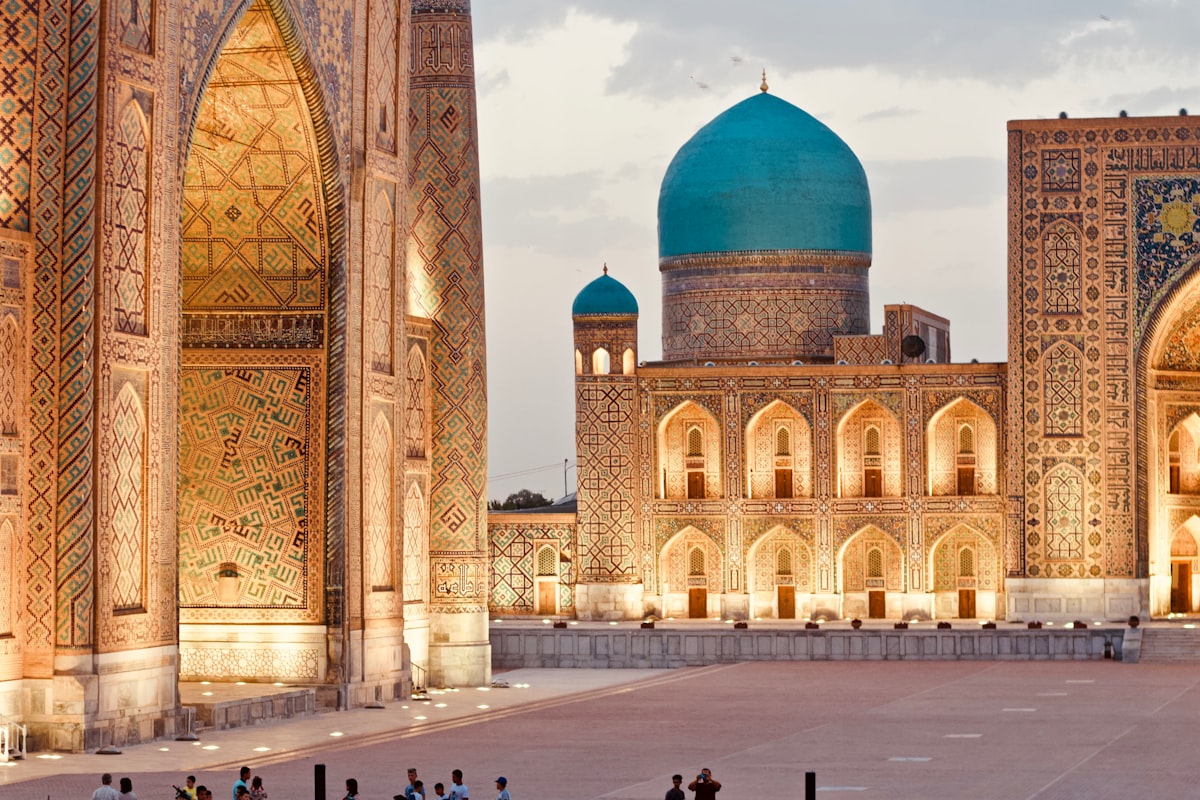
My name is Dilnoza and I am eleven years old. I live in a city in Uzbekistan, a country in the middle of Central Asia where the ancient Silk Road once passed through. Merchants carrying silk, spices, and jewels used to travel through my city on camels a thousand years ago. The buildings they left behind are covered in blue mosaic tiles that shine in the sun like the sky broke apart and stuck itself to the walls. I never get tired of looking at them.
Every morning my mother cooks eggs in a small iron pan and heats up round flatbread called non that she baked the day before in our clay oven. The oven is called a tandyr, and it is shaped like a beehive. She slaps the dough against the inside wall and it sticks there, baking until it puffs up with a crispy golden crust. We eat the bread with butter, apricot jam, and slices of white cheese. My father drinks green tea from a small bowl, not a cup, a bowl, and my brother and I share a pot of warm milk. The flatbread is so good fresh that sometimes I eat three pieces before my mother tells me to stop.
After breakfast I walk to school past the big square where the blue-tiled mosque stands. The tiles are turquoise and cobalt, arranged in geometric patterns, stars inside stars inside stars, so detailed you could stare at them for an hour and still find new shapes. My teacher says these patterns were designed by Uzbek mathematicians hundreds of years ago, and that they used geometry to create beauty without drawing any pictures of people or animals. I think that is clever.
In the afternoon, I visit my grandmother. She is teaching me suzani, a type of embroidery that Uzbek women have done for centuries. We sit on a low platform covered in cushions and she shows me how to stitch flowers, vines, and sun-shaped circles onto cotton cloth using silk thread in red, blue, green, and gold. A single suzani can take months or even years to finish. My grandmother is working on one for my older sister’s wedding, it will hang on the wall of her new home. Every stitch is tiny and precise. My grandmother says a suzani tells the story of the woman who made it. I am just learning, so my story is still short. But I am getting better.
On Sundays, our family’s day together, my father takes us to the chaikhana, which is the teahouse. The chaikhana has a grape arbor over the courtyard and low wooden platforms with carpets and cushions where families sit cross-legged around a cloth spread with food. My father orders plov, a huge dish of rice cooked with carrots, onions, chickpeas, raisins, and chunks of lamb, all flavored with cumin and cooked in a giant black pot called a kazan. The rice is golden from the carrots and glistening with oil, and the lamb falls apart when you touch it. Plov is the most important food in Uzbekistan. Weddings have plov. Funerals have plov. Every celebration and every sadness, plov is there. Have you ever had a food that shows up at every important moment in your family’s life?
At night, when the city quiets down, my father and I sometimes walk to the old square. The mosaic tiles glow blue under the floodlights, and the air is cool and smells like dust and cotton blossoms. He tells me that Samarkand was once one of the greatest cities in the world, that scholars and poets and scientists came from everywhere to study here. He says I should be proud of where I come from. I am.
What is the oldest building or place near where you live? Does it tell a story?
I am Uzbek. We are the people of the Silk Road, of blue tiles and golden plov, of embroidery that takes years and bread baked on the walls of clay ovens. This is my home, and its story is still being written.
Fun Facts
- Samarkand and Bukhara, two of Uzbekistan’s most famous cities, were major stops on the ancient Silk Road, the 4,000-mile trade route that connected China to Europe for over 1,500 years.
- Plov (rice pilaf) is so central to Uzbek culture that UNESCO added the tradition of preparing and sharing it to its list of Intangible Cultural Heritage. In Uzbekistan, plov is typically cooked by men in enormous kazan pots that can serve hundreds of people.
- The Registan Square in Samarkand, covered in blue mosaic tiles, is considered one of the most beautiful public squares in the world, its three massive madrasas (schools) were built in the 1400s and 1600s.
- Uzbek suzani embroidery was traditionally made by brides and their mothers as part of a dowry. The designs include pomegranates (for fertility), sun discs (for protection), and vines (for life), all stitched by hand in silk thread.
- Uzbekistan is one of the world’s largest cotton producers, and cotton has been grown here for over a thousand years. The white cotton bolls open in autumn and cover the fields like snow.
How to Pray for the Uzbek
- Pray that Uzbek families who gather at the chaikhana to share plov and tea would hear about Jesus, the God who invites everyone to His table and calls them family.
- Pray for the small number of Uzbek Christians who face pressure from their families and communities, that God would strengthen them and help them share their faith with courage and kindness.
- Pray that Uzbek children like Dilnoza would have the chance to read the Bible in Uzbek and discover that the God who inspired the beauty of Samarkand’s tiles also made them and loves them.
How Kids Can Help
- Pray: The next time you eat rice, think of Uzbek families gathered around a steaming pot of plov, and pray that God would reveal Himself to them in a way that feels like coming home.
- Learn: Look up pictures of the Registan Square in Samarkand and the blue mosaic tiles. Learn one fact about the Silk Road and share it with your family.
- Share: Tell a friend about the Uzbek people, most kids have never heard of Uzbekistan, and sharing even a few facts can open someone’s eyes to a part of the world they did not know existed.
- Give: Ask your parents about supporting Bible distribution and Christian radio ministries that reach Uzbek-speaking families across Central Asia.
Scripture to Remember
“Your hands have made and fashioned me; give me understanding that I may learn your commandments.” (Psalm 119:73, ESV)