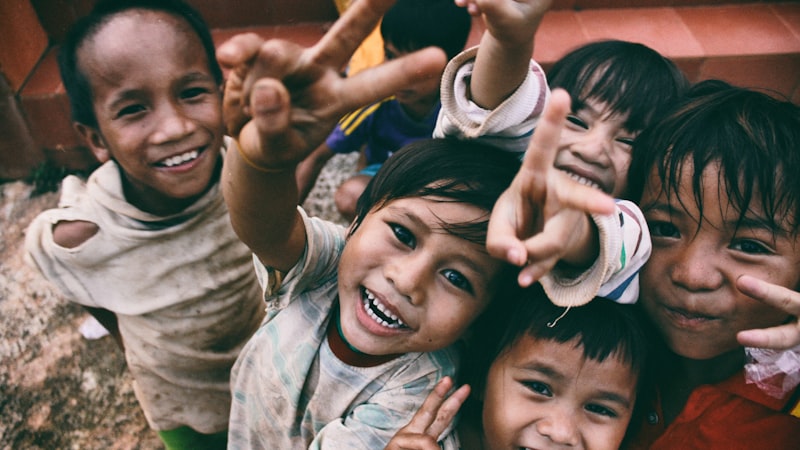
How Kids Can Be Senders
The crayon smelled like burnt wax and grape candy. Ten-year-old Mia pressed it hard against the card stock, drawing a wobbly sun over a stick-figure family standing outside something that was supposed to be a hut but looked more like a mailbox. She wrote beneath it in careful letters: Dear Mr. and Mrs. Chen, We are praying for you every night. My little brother prays too but he mostly just says “Jesus help the Chens eat good food.” She folded it, sealed it with a heart sticker, and dropped it into the shoebox her Sunday school class was mailing to Southeast Asia.
That letter traveled 8,400 miles. It arrived in a village where the temperature hovered near a hundred degrees and the humidity stuck to your skin like warm tape. And when Sarah Chen opened it at her kitchen table, a plastic folding table wedged between a propane stove and a stack of language-learning notebooks, she cried. Not because the drawing was beautiful (it wasn’t). Because someone remembered.
If your family is exploring how to teach kids about world missions, one of the most important truths to land early is this: God’s heart for the nations includes people who never board the plane. The Church has always needed senders. And kids can be some of the best ones.
What Does It Mean to Be a Sender?
The word sounds simple. A sender is someone who helps someone else go. But in the Bible, sending is not a lesser role. It is the other half of the mission.
In Romans 10:15, Paul asks:
“How are they to preach unless they are sent? As it is written, ‘How beautiful are the feet of those who preach the good news!’” (ESV)
He doesn’t treat sending as backup work or second-string duty. He frames it as essential, the kind of essential where, if nobody does it, the whole thing stops. The missionaries Paul knew were sustained by churches who prayed for them, collected money for them, housed them between trips, and carried their letters from city to city. Those believers in Philippi who gave Paul financial support, he called their gift “a fragrant offering, an acceptable sacrifice, pleasing to God” in Philippians 4:18. That is not how you describe a minor role.
Sending is a calling. It’s just a different one.
Here is the thing most children (and plenty of adults) don’t realize: for every missionary family living overseas, there is usually a team of dozens, sometimes hundreds, of people back home making it possible. People who write checks. People who organize supply shipments. People who forward emails to their prayer groups at six in the morning. People who remember birthdays and send packages that smell like home.
Kids can do this. They are already wired for it.
Five Ways Kids Can Be Senders
1. Pray by Name
This is the most powerful thing a sender does. It costs nothing. It requires no shipping label.
A seven-year-old can learn the name of a missionary family and say that name out loud before bed. That’s it. That’s the whole skill. And according to Scripture, those prayers have weight. James 5:16 tells us that “the prayer of a righteous person has great power as it is working” (ESV), and Jesus himself said in Matthew 18:20, “Where two or three are gathered in my name, there am I among them” (ESV).
Get specific. Don’t just pray “help the missionaries.” Pray for the Chen family’s language study. Pray for their daughter who misses her cousins. Pray for the neighbor who keeps bringing them bowls of rice porridge and asking questions about their faith. Specificity turns prayer from routine into relationship. (If you need help teaching your kids to pray for specific groups of people around the world, our guide on how to pray for unreached people groups with your kids has age-appropriate ideas for every stage.)
2. Write Letters and Send Cards
Mia’s crayon drawing wasn’t art. It was oxygen.
Missionaries report that one of their deepest struggles is feeling forgotten. The first year overseas is full of energy and support. By year three, the emails slow down. By year five, some missionary families hear from almost no one outside their sending agency. A hand-drawn card from a child, smudged with marker ink and probably a little peanut butter, is a tangible reminder that somebody back home still cares.
Practical ideas:
- Write a short letter once a month to a specific missionary family your church supports
- Draw pictures of your town, your pets, your school, ordinary details feel like gifts when you live far from home
- Send photos of your family (printed ones, not just digital, a physical photo can go on a refrigerator or a wall)
- Record a short video prayer and email it
The texture of paper matters. The weight of an envelope matters. Something held in the hand reaches the heart differently than pixels on a screen.
3. Give Money. Even Small Amounts
A jar of coins can do real work.
When kids save their own money and choose to give it to missions, something shifts inside them. It stops being abstract. It becomes theirs. The quarter they earned by sweeping the garage, the dollar bill from Grandma’s birthday card, when they drop it into a missions jar, they have something of their own invested in the mission.
Some families set up three jars: Save, Spend, Give. The Give jar funds go to a missionary or missions organization the child has picked out themselves. Other families do bake sales, lemonade stands, or neighborhood car washes where the kids decide in advance that the money goes to support a specific missionary. One family in Ohio raised $340 for Bible translation through a Saturday popcorn stand. The kids popped it. The kids bagged it. The kids counted the money. They still talk about it years later.
Paul held up the churches of Macedonia as an example in 2 Corinthians 8:2-4, they gave generously out of their own poverty, and they “earnestly begged us for the favor of taking part in the relief of the saints” (ESV). Giving was not obligation for them. It was privilege. Kids can learn that posture early.
4. Pack Care Packages
There is a ministry in the cardboard box.
Missionaries living overseas often cannot find familiar foods, toiletries, or household items. A care package stocked with specific things they’ve requested, a particular brand of peanut butter, ranch dressing mix packets, children’s vitamins, coloring books in English, AA batteries, is practical love in physical form.
Let kids do the shopping. Let them compare prices at the store. Let them wrap each item in tissue paper (or newspaper, missionaries don’t care about presentation, they care about contents). Let them write a note to tuck inside. The smell of a dryer sheet tucked between items can make a grown adult homesick and grateful at the same time.
One missionary in Central Asia described opening a package that contained exactly one thing: a bag of Sour Patch Kids candy. Her eight-year-old daughter held the bag against her face and breathed in. “It smells like Target,” she said.
Details like that stay with you.
5. Learn and Share Their Stories
Senders don’t just give. They advocate. They talk about the people they support. They tell their friends, their grandparents, their soccer teammates. A child who knows the story of a missionary family, where they live, what language they’re learning, what the food tastes like there, what their kids’ names are, becomes a walking invitation for others to care.
This is how support networks grow. Not through marketing campaigns, but through a nine-year-old saying at dinner, “Did you know the Rodriguezes in Ecuador had a water pipe break in their house and they had to carry buckets from the river for two weeks?”
That’s sending. That’s keeping someone’s story alive in a place where it could easily be forgotten.
The Story of the Sunday School Class That Built a Well
In 2019, a group of eleven kids at a church in rural Georgia decided they wanted to help a missionary couple in East Africa who kept mentioning in their prayer letters that the nearest clean water source was a forty-minute walk from the village. The kids were between eight and twelve years old. They didn’t have wealthy parents. They lived in a town where the biggest employer was a poultry processing plant.
They did three things. They prayed for the water situation every Sunday for six months, out loud, by name, kneeling on the thin carpet of their classroom. They wrote letters to the missionary couple asking specific questions about the village and the water (How heavy are the buckets? Do the kids help carry them? What does the water look like before it’s boiled?). And they raised money.
They raised it slowly. Dollar by dollar. They sold homemade dog biscuits. They did yard work. They asked family members to sponsor their efforts. Over nine months, those eleven kids raised just over $2,800. It wasn’t enough for a full well, those cost between $5,000 and $15,000 depending on depth and location, but their church saw what the kids had done and matched the funds. Then another church heard and contributed.
The well was drilled. Clean water came up. The missionary sent a video of children in the village drinking from the new pump, water running down their chins and soaking their shirts, laughing.
Those eleven kids never left Georgia. They were senders.
What Scripture Says About the Sender’s Role
The Bible doesn’t treat sending as a consolation prize for people who aren’t brave enough to go. It treats it as partnership.
Paul’s letter to the Philippians reads like a thank-you note to senders. “I thank my God every time I remember you,” he writes in Philippians 1:3-5, “because of your partnership in the gospel from the first day until now.” That word, partnership, is the Greek word koinonia. It means shared participation. It means Paul considered the Philippians co-laborers, not donors. They shared in the work because they made the work possible.
In 3 John 1:5-8, the apostle John commends a man named Gaius for showing hospitality to traveling missionaries. John writes, “Therefore we ought to support people like these, that we may be fellow workers for the truth” (ESV). There it is again. Fellow workers. Senders and goers are on the same team, doing the same mission, from different locations.
This matters for kids because it means their prayers, their letters, their crumpled dollar bills, their shoeboxes of crayons and candy, all of it counts. Not symbolically. Actually. God uses senders to sustain goers, and the work of the gospel moves forward on both sets of legs.
Starting the Sender Habit Early
You don’t need a program. You need a name.
Pick one missionary family. Learn about them. Put their photo on the refrigerator, right next to the grocery list and the school lunch menu and the crayon drawing of a dinosaur. Pray for them at dinner. Not every night (that becomes rote), but often enough that their names feel familiar in your children’s mouths.
Write them one letter. See what happens. See if your kids ask questions. See if they want to know what the food is like there, whether the missionary’s kids have pets, what the weather feels like. Let curiosity do the work.
And when your children bring their coins to the Give jar, let them hold the money in their hands for a moment first. Let them feel the weight of it. Then let them drop it in and hear the clink. That small sound, metal on glass, is the sound of partnership. It’s the sound of a child joining God’s heart for the nations from right where they are. For a picture of what sustained sending makes possible, read the story of Amy Carmichael in India, who stayed fifty-five years because faithful senders kept her there.
If your family uses missions prayer cards, those are a natural place to start: a face, a name, a few facts, and a prompt to pray. The card goes on the dinner table or the dashboard or the nightstand, and suddenly that unreached people group on the other side of the world has a place in your family’s daily rhythm.
Every goer needs a sender. And every child who is willing is already enough.
God does not measure the offering by its size. He measures it by the heart behind the hand that holds it out.
Brought to you by Wonder Letters
Monthly missions letters for families. 50% of profits support Global Serve International.