
Missions Coloring Pages for Kids
The crayon was called “burnt sienna,” and six-year-old Nadia pressed it hard against the paper, filling in the walls of a mud-brick house that sat at the edge of a drawn desert. The coloring page showed a Tuareg family outside their home in Niger, a woman in an indigo headwrap grinding millet in a tall wooden mortar, a man adjusting the saddle on a camel, two children chasing a goat around the corner of the house. The sky was left blank, waiting for whatever color Nadia would choose. She picked yellow. Bright, hot yellow. The kind of yellow that burns.
She was sitting at a plastic table in the fellowship hall of her church in Tallahassee, Florida. The room smelled like off-brand fruit punch and the slightly waxy scent of new crayons. Her Sunday school teacher had printed the coloring pages that morning and stacked them next to a basket of crayons and a small laminated map of West Africa. Nadia did not know where Niger was before she started coloring. Now she did, her teacher had pointed to it on the map, and Nadia had traced the shape with her finger. It looked like a frying pan.
She also knew, because her teacher told her while she colored, that the Tuareg people speak Tamashek, that they are sometimes called the “blue people” because the indigo dye from their clothing stains their skin, and that almost none of them have heard the gospel in their heart language.
Nadia colored for twenty minutes. She did not fidget. She did not ask to go to the bathroom. She did not poke the boy sitting next to her. She was fully absorbed in a scene from a country 5,000 miles from her plastic table.
That is what a good coloring page does. It holds a child still long enough for the world to get in.
If your family or church is building a library of missions activities and printables, coloring pages are the entry point for the youngest learners, the children who cannot yet read a prayer card or follow a recipe but can hold a crayon and look at a picture.
Why Coloring Teaches More Than You Think
There is a reason occupational therapists use coloring in development assessments. The act of coloring activates fine motor control, spatial reasoning, color recognition, and sustained attention simultaneously. But for missions education, coloring does something more specific: it forces a child to look closely.
A child who glances at a photograph of a Kazakh family inside a yurt sees “a tent.” A child who spends fifteen minutes coloring that same scene, filling in the felt walls, the stacked quilts, the low round table set with baursak (golden fried bread puffs) and bowls of kumis (fermented mare’s milk), sees details. She sees the patterns on the textiles. She sees the food on the table. She sees the faces.
Attention creates connection. That is not educational theory. That is how God made the human heart.
In Psalm 139, David marvels that God knows him with exhaustive specificity, every thought, every movement, every word before it reaches his tongue. God pays attention to detail because he loves in detail. When we teach children to pay close attention to the lives of people from other cultures, we are teaching them a small version of how God sees.
Crayons are a tool. Never underestimate them.
What Makes a Good Missions Coloring Page
Not all coloring pages are equal. A generic outline of a child holding a globe teaches a child nothing except how to stay inside the lines. A missions coloring page should do three things:
1. Show a Specific Scene from a Specific Culture
Not “children in Africa” but “a Fulani girl in northern Nigeria braiding her younger sister’s hair outside their family’s compound, with a thatched granary and a herd of white cattle in the background.” The specificity matters. A Fulani scene is different from a Wolof scene is different from a Hausa scene, even though all three live in the same country. When a coloring page names the people group, it teaches children that God sees peoples, not just countries.
2. Include Culturally Accurate Details
The architecture should be right. The clothing should be right. The food should be right. A Berber home in the Atlas Mountains has thick stone walls and flat roofs for drying figs and olives in the sun. A Malay fishing village has wooden houses on stilts above the water, with painted hulls of boats pulled up on the sand. These details are not decorations, they are the texture of real life, and they deserve the dignity of accuracy.
3. Include a Caption with a Name, a Place, and a Prayer Point
At the bottom of every coloring page, one or two sentences: “The Khmer people of Cambodia. They live in wooden houses built on stilts above the floodplain. Pray that the Khmer people would hear about Jesus in their heart language.” The caption turns coloring from an activity into an act of intercession. Even a child who cannot read will hear it when a parent or teacher reads it aloud.
Coloring Pages by World Region
Here is a collection of scenes organized by region. Each one is designed to be printed, colored, and discussed, in a home, a classroom, a church hallway, or a minivan.
South Asia
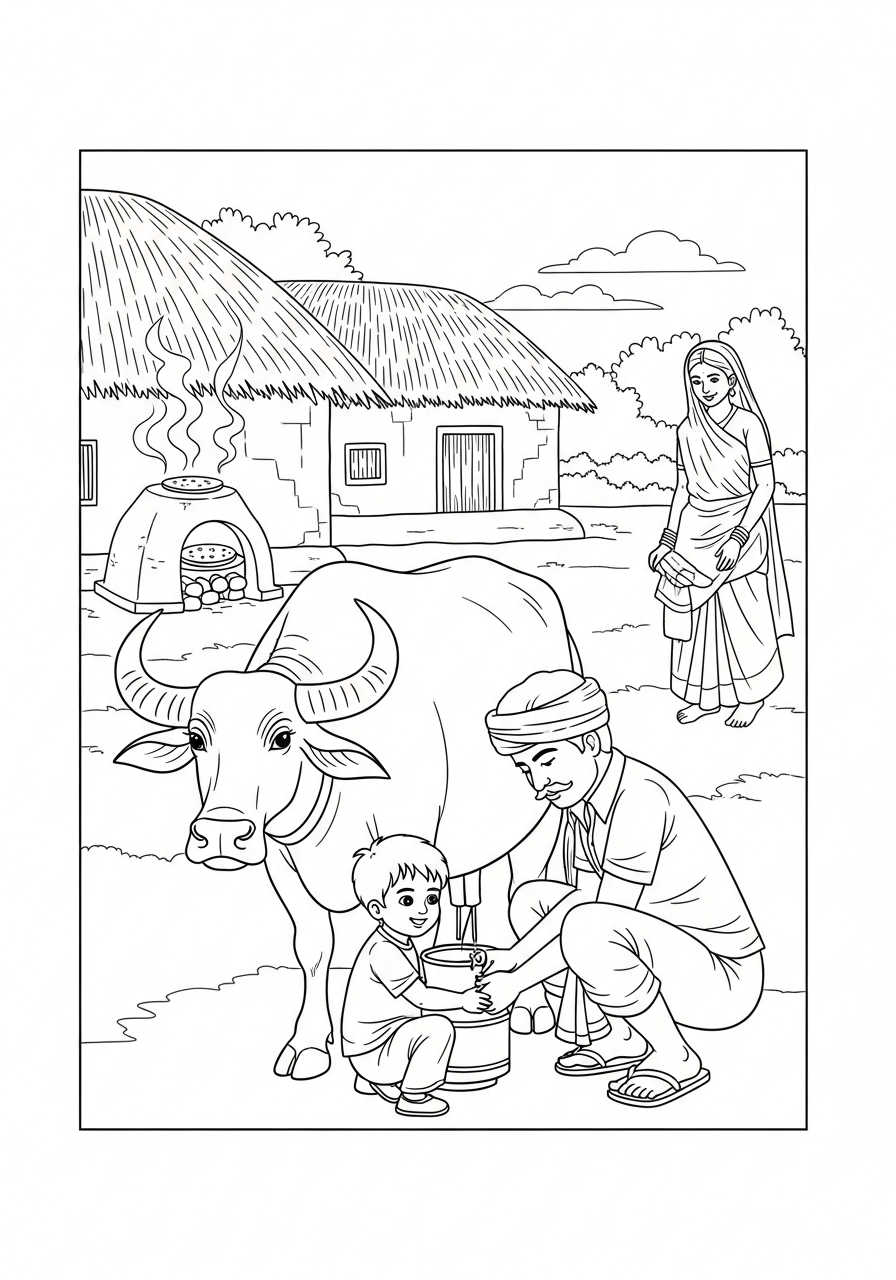
A Yadav Family at Morning Milking. A father and son crouch beside a water buffalo in the misty dawn light of Uttar Pradesh, India. A tin pail catches the warm milk. In the background, a mud-walled house with a thatched roof. Smoke rises from a clay oven where the mother is making roti.
Caption: The Yadav people of India. Over 60 million people, most of whom have never heard the gospel. Pray for God to send workers to the villages of Uttar Pradesh.
 Right-click and save to print this coloring page.
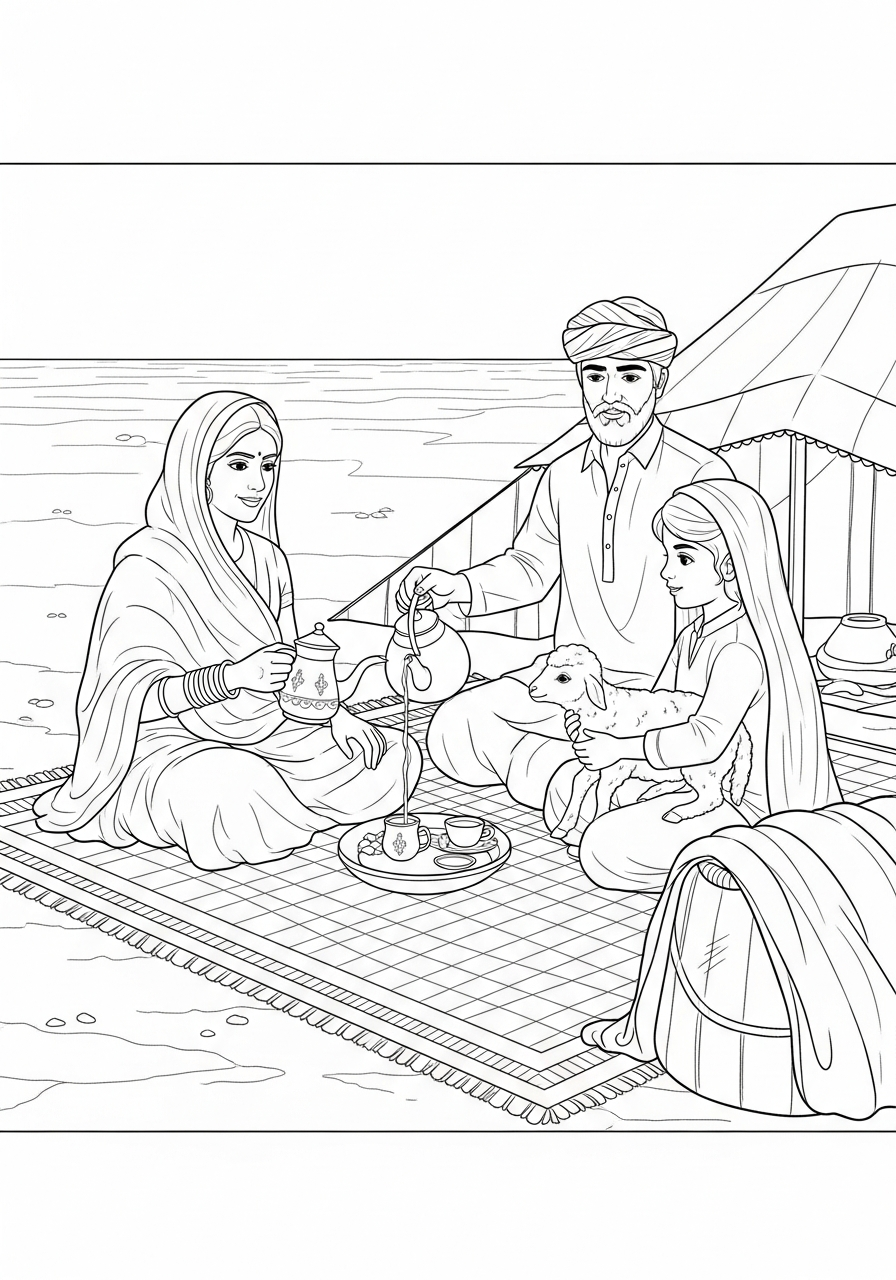
A Baloch Camp in the Desert. A family sits on a woven carpet outside a low tent in the desert of Balochistan, Pakistan. A woman pours tea from a brass pot. A child holds a small lamb. The desert stretches flat to the horizon under a white sky.
Caption: The Baloch people of Pakistan and Iran. They are nomadic herders who travel with their flocks across vast deserts. Pray for the Baloch to hear God’s word in Balochi, their heart language.
 Right-click and save to print this coloring page.
Central Asia
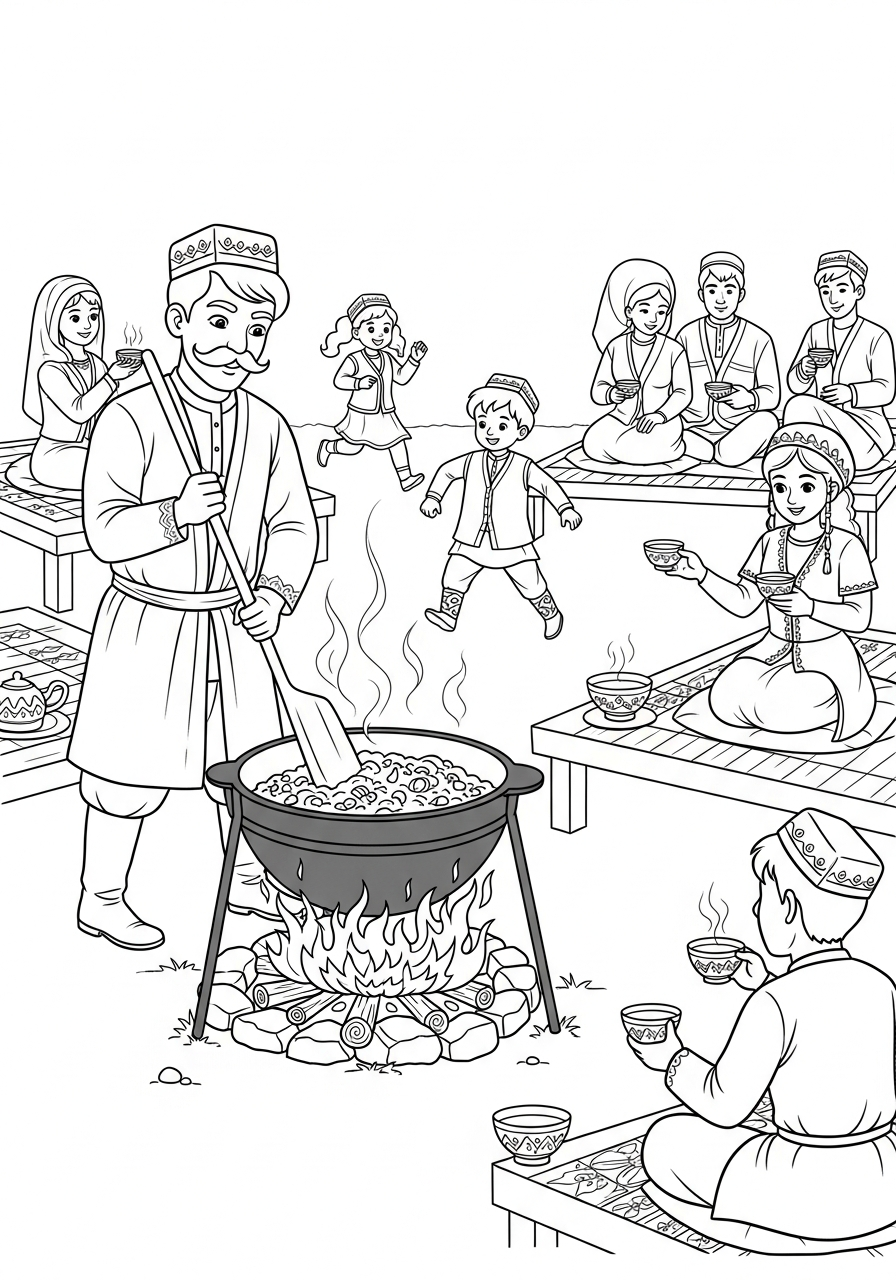
An Uzbek Wedding Feast. A man stirs an enormous kazan (cast-iron pot) of plov over an outdoor fire. Guests sit on low platforms called tapchans, drinking tea from painted bowls. Children run between the tables. The air is thick with the steam of rice, lamb, and caramelized carrots.
Caption: The Uzbek people of Uzbekistan. Plov is served at every celebration, and hospitality is a sacred duty. Pray that God’s generosity would become known among the Uzbek people.
 Right-click and save to print this coloring page.
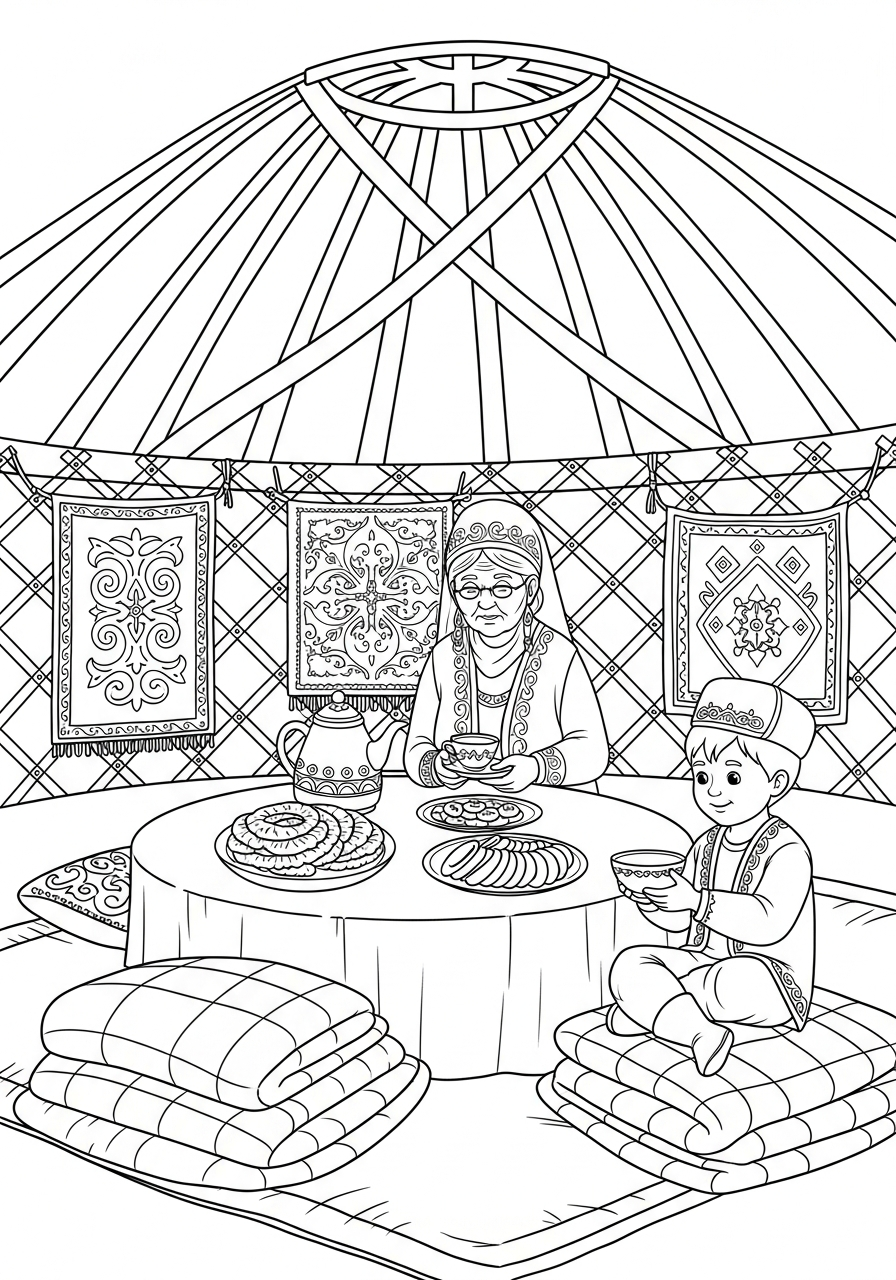
A Kazakh Family Inside a Yurt. A grandmother serves tea and baursak on a low table in the center of a felt-walled yurt. Colorful textiles, red, blue, gold, hang on the walls. A child sits cross-legged on a stack of quilts, holding a bowl of kumis.
Caption: The Kazakh people of Kazakhstan. Pray for Kazakh believers, small in number but faithful, and for the gospel to spread across the steppe.
 Right-click and save to print this coloring page.
Middle East and North Africa
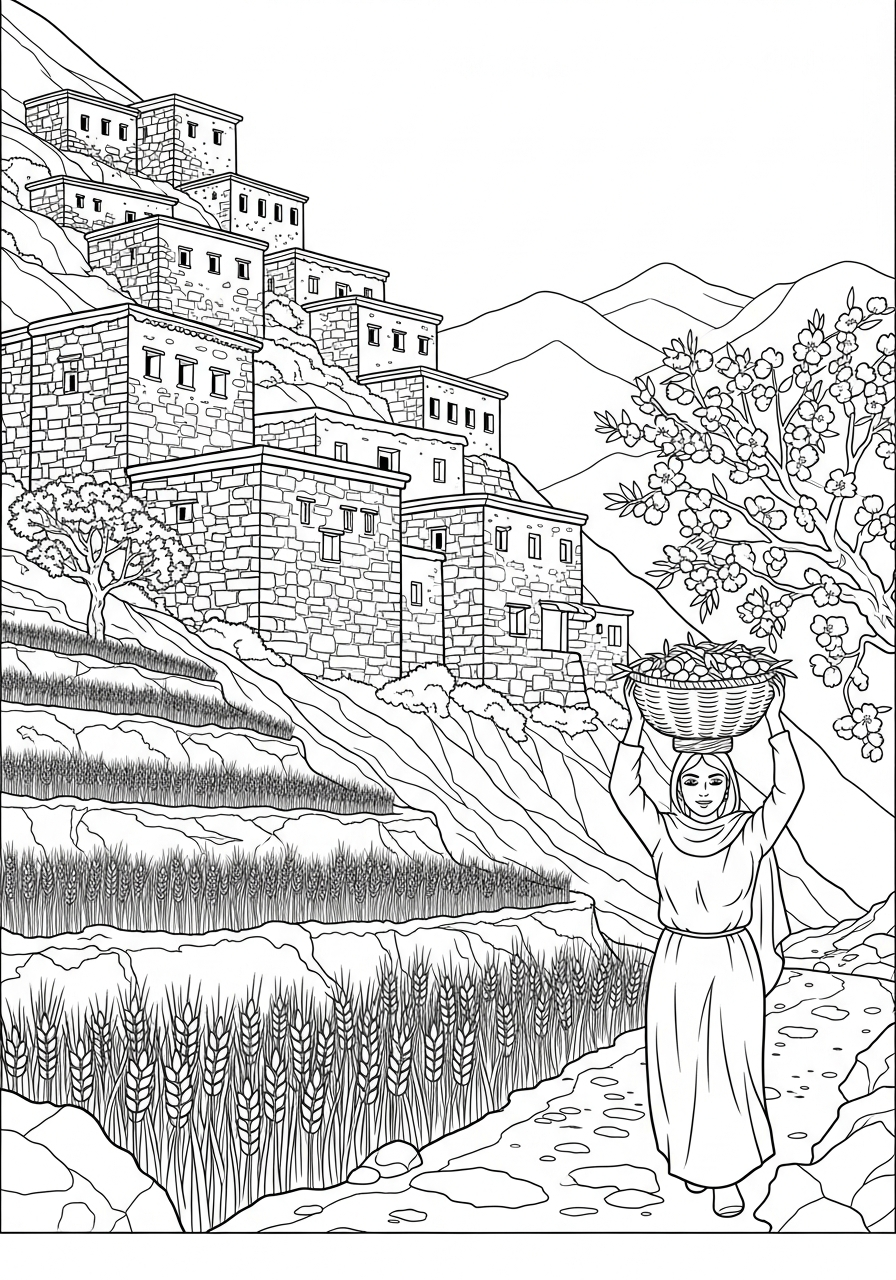
A Berber Village in the Atlas Mountains. Stone houses with flat roofs cling to a steep hillside. A woman carries a basket of olives on her head. Terraced fields of wheat step down the mountainside. An almond tree blooms white against the brown rock.
Caption: The Berber (Imazighen) people of Morocco. They call themselves “the free people.” Pray for freedom in Christ to reach the mountain villages of the Atlas.
 Right-click and save to print this coloring page.
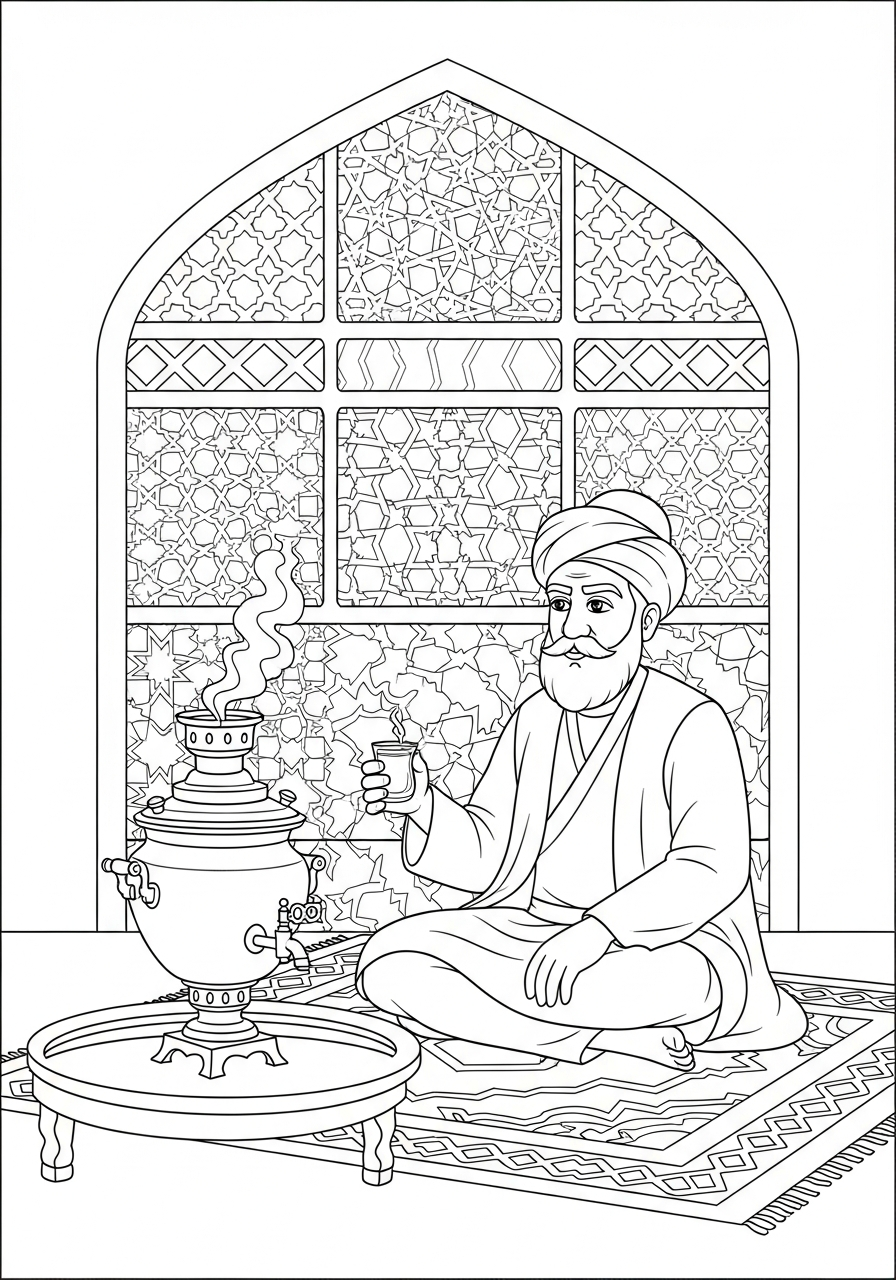
A Persian Tea House. A man sits cross-legged on a carpet, holding a small glass of tea with a sugar cube between his teeth. A copper samovar steams on a low table. The walls are decorated with geometric tilework in turquoise and cobalt blue.
Caption: The Persian people of Iran. Persian hospitality always begins with tea. Pray for the underground church in Iran, growing, courageous, and in need of prayer.
 Right-click and save to print this coloring page.
East Africa
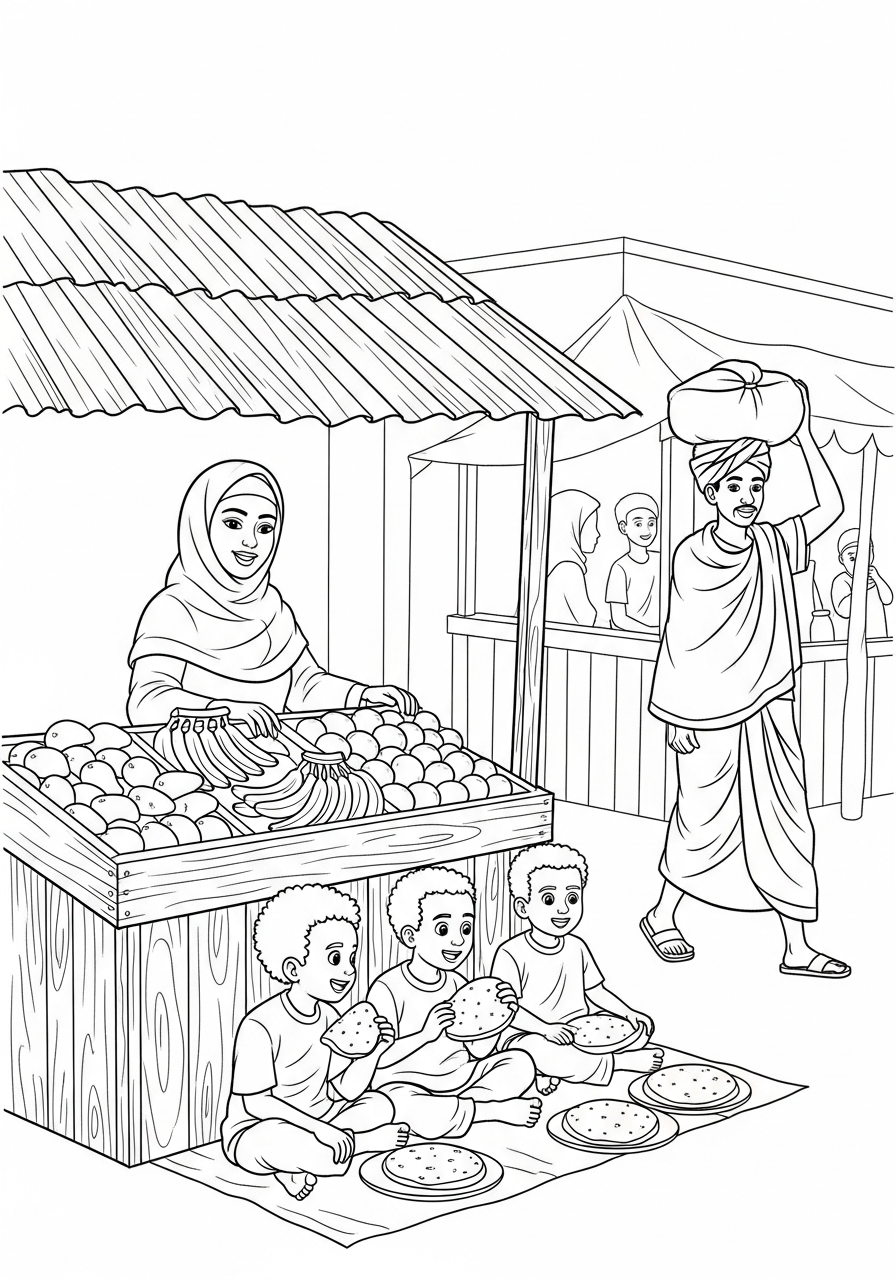
A Somali Market Scene. A woman sells mangoes and bananas from a wooden stall. A man in a macawis (a wraparound cloth) carries a bundle of khat leaves. Children sit in the shade of a corrugated tin awning, eating anjero with their hands.
Caption: The Somali people of East Africa. Over 23 million people, with very few followers of Jesus. Pray for the Somali people to encounter the gospel through the kindness of those who come to live among them.
 Right-click and save to print this coloring page.
Southeast Asia
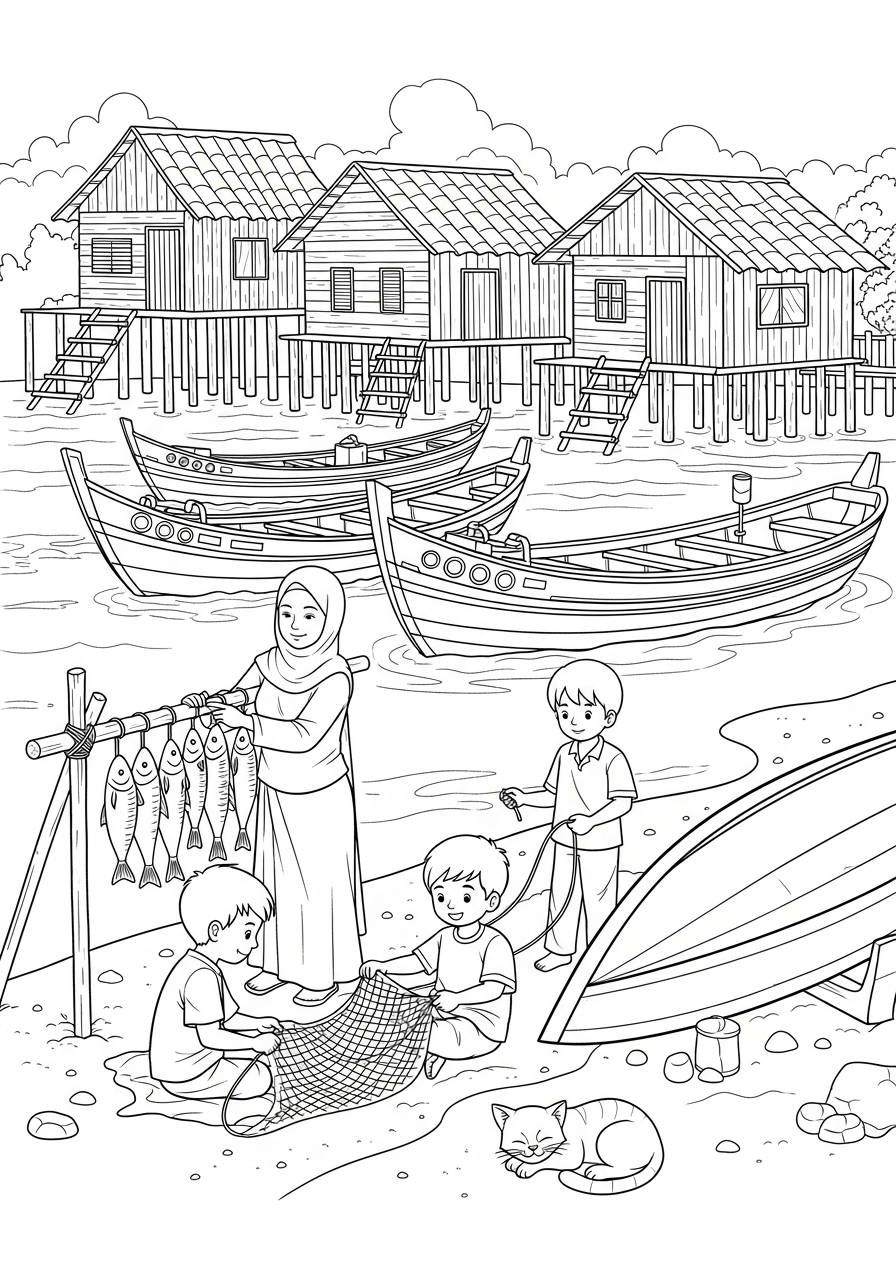
A Malay Fishing Village. Wooden houses on stilts above the water. Brightly painted fishing boats rest on the sand. A woman hangs salted fish on a drying rack. Two boys mend a fishing net while a cat sleeps in the shade of an overturned hull.
Caption: The Malay people of Malaysia. Pray for the Malay people, who are deeply rooted in Islamic faith, to discover the God who made the sea and everything in it.
 Right-click and save to print this coloring page.
How to Use Coloring Pages in Different Settings
In Church: Sunday Morning and Wednesday Night
Distribute coloring pages during the sermon as quiet activities for younger children. When the coloring page is missions-focused, even the “quiet time” becomes formational. Post finished pages on a hallway bulletin board labeled “We Are Praying for the Nations.” Over months, the board fills with colored scenes from around the world, a visual testament to a church that is raising its children with God’s heart for the nations.
In Homeschool: Paired with Geography
Color the Berber village while studying Morocco. Locate the Atlas Mountains on a map. Calculate the distance from your kitchen table to Marrakech. Read about the history of the Berber people. Write a paragraph about what you see in the picture. One coloring page has just generated a geography lesson, a math problem, a history reading, and a writing assignment.
For a full framework on combining geography and missions, see our missions through geography unit.
In Family Devotions: Color and Pray
Give every family member the same coloring page. Color together for ten minutes. Then each person shares one thing they noticed, a detail in the scene, a fact from the caption, something they want to pray about. Close with prayer for the people group on the page. The four-year-old will notice the goat. The ten-year-old will notice the clothing. The parent will notice the prayer point. All of them are seeing the same people group from different angles.
In VBS or Summer Camp: Passport Stations
Set up coloring stations as part of a “Passport Around the World” experience. Each station features a different region and a different coloring page. Children travel from station to station, coloring one page at each stop and getting their paper passport stamped. By the end of the week, they have a stack of colored scenes from around the world, and a set of names and prayer points they did not know five days earlier.
For more on building a full VBS experience around missions, see our missions VBS curriculum ideas.
Making Your Own Coloring Pages
You do not need to be an artist. You need a scene, a pencil, and a willingness to draw imperfectly.
Step 1: Choose a people group. Go to joshuaproject.net and select one. Read about where they live, what they eat, what their homes look like.
Step 2: Sketch a scene from daily life. Not a crisis. Not poverty. Daily life. A family eating. A woman weaving. Children playing. A market. A tea shop. A farm.
Step 3: Simplify the lines for coloring. Thick outlines, open spaces, minimal shading. The child will add the color. Your job is the framework.
Step 4: Add the caption at the bottom. People group name. Location. One prayer point. Keep it short.
Step 5: Photocopy and distribute. Or scan and email as a PDF. The technology is less important than the theology, every coloring page puts a face on God’s heart for the nations.
If your artistic children want to draw the coloring pages themselves, let them. A twelve-year-old who researches the Tuareg people and then draws a scene of Tuareg life has done more deep learning in that single act than in a week of reading.
The Theology of Looking Closely
There is a reason God filled the world with 17,000 people groups instead of one. He is a God of infinite creativity, and the diversity of human culture, the 7,000 languages, the ten thousand ways to make bread, the uncountable patterns of cloth and song and architecture, reflects something true about his character.
When a child picks up a burnt sienna crayon and carefully fills in the walls of a Tuareg home, she is paying attention to a corner of God’s creation that most of the world ignores. She is practicing the discipline of seeing. And in the seeing, something shifts, the Tuareg stop being strangers and start being neighbors. Distant, yes. Unknown, mostly. But real. Colored in. Prayed for.
God sees every people group with the same exhaustive attention he gives to the sparrow and the lily. He knows the Tuareg by name. He knows the Kazakh. He knows the Baloch.
He is asking us to look, and a box of crayons is enough to begin.
Brought to you by Wonder Letters
Monthly missions letters for families. 50% of profits support Global Serve International.